Friday, October 30, 2009

Chevron’s Ready-Made Scandal Continues to Fall Apart

New post from Paul over at ChevroninEcuador.com:

Chevron's Ready-Made Scandal Continues to Fall Apart


A new Associated Press investigation revealed that the purported environmental remediation specialist, Wayne Douglas Hansen, who secretly filmed meetings meant to catch Ecuadorian officials in acts of corruption has never owned a remediation company—as claimed—nor does he have any relationship with Honeywell Inc. as claimed in one of the videos.

AP reporters interviewed Hansen on the phone earlier this month. When they asked him the name of his company, he refused to answer. He instead described water treatment projects he is working on in Mexico and Ecuador. When the reporters questioned him about details of these projects, he hung up.

The AP investigation also uncovered Hansen's repeated run-ins with the law, ranging from letting his pit bull go wild on a neighbor's dog, to conspiring to smuggle 275,000 pounds of marijuana from Colombia into the United States! (He was convicted and served time in federal prison.)

The investigation shatters Chevron's attempt to portray Hansen as a sincere, concerned citizen who hand delivered the supposed bribery videos out of a sense of civic duty.

A parallel plaintiffs' report on Hansen was also published today, going into exhaustive detail on the information recently uncovered.

What remains to be uncovered is: one, the extent to which Hansen's involvement in the video scandal constitutes a federal crime for violating the Foreign Corrupt Practices Act and two, whether Chevron knowingly participated with Hansen in illegal activity to get their hands on a "smoking gun."

– Paul

Chevron’s “Good Samaritan” is a Drug Trafficker and a liar…

An article in the New York Times today outlines the latest findings about the American, Wayne Hansen, who supposedly owned a remediation company, and who Chevron claimed made secret videotapes to expose "corruption" out of the goodness of his heart. Well, turns out that almost everything the guy said about who he was and who Chevron claimed he was is a lie – he does not own a remediation company, he has never done any remediation, and he is a convicted felon (For trying to smuggle 275,000
pounds of drugs).

And this brings up a serious question: if the guy isn't who Chevron says he is, and if he wasn't actually looking for remediation contracts (since he didn't have a remediation business), what was he doing in meetings, asking leading questions, while he secretly videotapes it? Why was he in that room? More and more signs are point towards Chevron, the only party that benefited from Hansen's attempt to undermine the trial in Ecuador.

Read on, from the Times:

October 30, 2009

Revelation Undermines Chevron Case in Ecuador

By CLIFFORD KRAUSS

HOUSTON — An American whose secret recordings have placed him at the center of a $27 billion lawsuit against Chevron in Ecuador is a convicted drug trafficker, records show, throwing another complication into a case already tainted by accusations of bribery and espionage.

The lawsuit pits Ecuadorean peasants against Chevron over oil pollution in the Amazon and has been a major headache for the company for nearly a decade, producing a saga that underscores many of the hazards and ethical challenges of oil companies working in the developing world.

The company appeared to gain the upper hand in August when it revealed video recordings — captured on watches and pens implanted with bugging devices — that suggested a bribery scheme involving Ecuadorean officials, and possibly even the judge hearing the case.

But the company was put on the defensive again on Thursday, after lawyers for the peasants revealed that one of two men who made the tapes was a convicted felon. Court and other records provided by the plaintiffs show that Wayne Hansen, the American who helped make the recordings, was convicted of conspiring to traffic 275,000 pounds of marijuana from Colombia to the United States in 1986. He also was sued successfully in 2005 by a woman who accused him of unleashing his two pit bulls to attack her and her dog.

The disclosure adds more questions about what motivated Mr. Hansen and an Ecuadorean partner to record meetings for Chevron's use, which the company has characterized as an act of whistle-blowing by men offended by unethical behavior and evidence that the handling of the case had been flawed.

"It's another blockbuster development in a case that never runs short of them," said Ralph G. Steinhardt, a professor at George Washington University Law School. "It doesn't necessarily mean there was no bribery plan, but anything that undermines the credibility of the witness undermines the case of the party that would call that witness."

Trevor Melby, Mr. Hansen's lawyer, did not deny his client had a criminal history, saying, "The thing about felony convictions is they follow you to the grave, but even if he had 15 felony convictions it wouldn't change the tapes." Mr. Melby said he was not being paid by Chevron.

The origins of the case go back to the 1970s, when Texaco operated in partnership with the Ecuadorean state oil company to produce oil in the Amazon. Peasants filed suit in 1993, saying that the company, which had ceased to operate in Ecuador by then, had left an environmental mess that had caused illnesses among villagers. Chevron bought Texaco before the case could be resolved.

Chevron has long said that it could not receive a fair hearing in Ecuador before a hostile judge and government. That argument seemed to be reinforced by the recordings obtained by Mr. Hansen and an Ecuadorean man who had worked as a contractor for the company. They showed an Ecuadorean political go-between working to obtain $3 million in bribes for environmental cleanup contracts to be awarded after the case ended.

But it remained unclear why Mr. Hansen was involved in the discussions. The plaintiffs said that an inquiry into his background by a private investigator found that Mr. Hansen did not hold an engineering license, never finished college and showed no record of being qualified to remediate pollution as he portrayed to Ecuadorean officials in the tapes.

Chevron has said it had no involvement in the videotaping, and company spokesmen have said Mr. Hansen was never their point of contact. "We've had no association with this guy," said Donald Campbell, a Chevron spokesman. "This issue is the content on the video and the transcripts that we turned over to the prosecutor general of Ecuador and the U.S. Department of Justice, which shows inappropriate meetings by the judge in our case, extensive government interference in the trial and a bribe plot involving $3 million."

The other man involved in making the recordings, Diego Borja, has since been moved to the United States with his family at Chevron's expense, and he has been receiving an undisclosed amount of living expenses.

No bribes were shown in the tapes, but the plot supposedly included Judge Juan Núñez, who was presiding in the case. Mr. Núñez recused himself, though he says he did nothing wrong.


Monday, October 26, 2009

Chevron Sullying Reputation of American Corporations Abroad; Garrigo Sullying Chevron’s Reputation at Home

Chevron's spokeswoman and resident "Misrepresenter in Chief" Silvia Garrigo was at it again during an interview with CNN's Rick Sanchez on Oct. 22. Garrigo, who professes to love the environment, last made headlines with her abysmal performance on CBS News' 60 minutes, where she dismissed health concerns in Ecuador's Amazon by comparing cancer-causing toxins in oil to the makeup on her face. This was Garrigo's classic line:

"I have makeup on, and there's naturally occurring oil on my face. Doesn't mean that I'm going to get sick from it."

The experts who run Chevron's embattled public affairs office either have very few options, or they apparently thought Garrigo's comparison of contamination to makeup was solid enough to put her on CNN. Garrigo was responding to Kerry Kennedy's account of her heartbreaking visit to the Ecuadorian rainforest where Texaco (now Chevron) intentionally dumped more than 18 billion gallons of toxic waste and abandoned over 900 unlined waste pits while operating a large oil concession from 1964 to 1990.

Kennedy, a mother of three and a longtime human rights advocate, described in detail the devastation she witnessed as a result of improper operating practices by Texaco (now Chevron). She told of the gasoline-like smell coming from the runoff from pipes intentionally designed by Texaco to discharge oil sludge and waste water from the pits directly into the rivers and streams used by the indigenous communities in the area for drinking, bathing, and cooking. She also recounted stories from the indigenous communities of rape and abuse at the hands of Texaco employees. This would not have occurred, she argued, if the residents were living in this country.

In response, Garrigo chided Kennedy for spending only a few days in the region -- as if it takes more than a few minutes to understand that huge open pits of oil, left untouched since Texaco abandoned them many years ago, are a mess that needs to be cleaned up. (Kennedy's trip is a few days more than any member of Chevron's management or Board of Directors has spent in Ecuador. No person with any real authority at the company – including outgoing CEO David O'Reilly, incoming CEO John Watson, outgoing General Counsel Charles James, and new General Counsel R. Hewitt Pate -- has been to the affected region of Ecuador.)

Garrigo then presented three arguments that she desperately wanted to share with the American public: 1) That Texaco had remediated its portion of the contamination and that what Kennedy saw was now the responsibility of Ecuador's government; 2) The cancer claims are false (Garrigo's apparent personal favorite); and 3) The Ecuadorian judiciary is corrupt.

All three arguments, not surprisingly, are either misleading or outright lies. The facts are as follows:

Garrigo: Any contamination Kennedy witnessed was caused by Petroecuador, Ecuador's state-owned oil company that inherited Texaco's well sites in 1992 when Texaco left the country.

Fact: Contrary to Garrigo's claim, Kennedy visited well sites built and run exclusively by Texaco. Aguarico 2 was solely operated by Texaco from 1974 to 1990 and then closed. This site was never operated by any other oil company. Kennedy dug mere inches into the ground before discovering oil in the soil, which is leaching into groundwater and ending up in the nearby stream where local residents drink the water. Kennedy saw the same contamination at Shushufindi 38, a pit opened by Texaco in 1975 and closed by Texaco in 1976. She also saw well site Aguarico 4, which was operated by Texaco from 1974 to 1984. In other words, Kennedy saw unlined waste pits built and closed by Texaco in the 1970s and 1980s that are still causing pollution today.

Texaco's so-called "remediation" cited by Garrigo involved fewer than 16% of the 916 pits that Texaco built. The remediation has been proven at trial to be either ineffective, or a complete fraud. Independent inspections of Texaco's "remediated" sites have found extensive levels of contamination, often thousands of times higher than the Ecuadorian norms that establish when human health is at risk. In fact, two Chevron lawyers and seven former Ecuadorian government officials are now under indictment for fraud connected to their involvment in the certification of the "remediated" pits. One of the Chevron lawyers under criminal indictment, Ricardo Reis Veiga, is thought of so highly by the company that he is still running Chevron's downstream operations in Latin America. (Reis Veiga also supervised Garrigo for several years on the Ecuador trial out of Chevron's office in Coral Gables.)

Garrigo: Any claims about health impacts in Ecuador from exposure to oil contamination are false.

Fact: It is well-established that exposure to any number of the chemicals and compounds that makeup oil is linked to higher instances of cancer – and numerous, peer-reviewed studies show elevated instances of cancer in the region of Ecuador which Texaco contaminated.

Is there anyone outside of Chevron who seriously believes there is no connection between consuming water and foods contaminated with oil and cancer? The independent, peer-reviewed studies measuring the impact of contamination on the health of people living in the Chevron concession area have found that cancer rates were anywhere from 1.7 to 4 times greater than for people living outside the area. One study found that the risk for spontaneous abortion was 2.34 times higher among woman living near the contamination. Based on survey data, the court Special Master calculated 1,401 excess cancer deaths resulting from the contamination. (Texaco, in the 26 years that it operated in Ecuador, never conducted a single health evaluation in the region nor took even one soil or water sample to determine if its operations were causing contamination.)

Garrigo: The courts in Ecuador are "corrupt to their core":

Fact: As Kennedy noted in her interview, the plaintiffs originally filed the lawsuit in New York Federal Court in 1993. Texaco and then Chevron fought to have the case removed to Ecuador arguing in 14 affidavits that the Ecuadorian judiciary was not only the more appropriate forum, but that the judicial system was competent and fair. Chevron won that battle, and the same case was re-filed in Ecuador in 2003. Once the trial started and evidence pointed to Chevron's culpability, Chevron changed its tune and started to attack the very courts it previously had praised. The animating principle: praise courts when you think you can win, condemn them when you think you are going to lose. But as Garrigo said on 60 Minutes when she got cornered by correspondent Scott Pelley, the reality is there is no court in the world that Chevron would agree to because Chevron is above the law and the claims relating to the pits Kennedy saw are "frivolous".

In reality, Chevron has tried to corrupt the Ecuadorian court process to derail the trial and evade a judgment – which explains why Chevron is under three separate official investigations for possible criminal violations relating to its misconduct in Ecuador. It also why Ecuador's Attorney General has asked the Department of Justice to investigate the company for violating the Foreign Corrupt Practices Act. Garrigo asks about corruption? She should just walk down the hall. Garrigo's colleagues at Chevron have fabricated a false military report to cancel the Guanta judicial field inspection, have filed redundant motions to delay the trial, have threatened various judges when they refuse to rule in the company's favor, and have harassed and stalked the court-appointed Special Master to the point where he needed police protection. Just weeks ago Chevron discovered a "bribery scandal" that has all the telltale signs of a hoax perpetrated by the company to sabotage the trial. That doesn't count the numerous and anonymous death threats leveled at plaintiff's counsel during the trial – threats that don't seem of great concern to Chevron, which has remained silent on this most critical of issues.

At the end of the interview, CNN anchor Rick Sanchez asked Garrigo if contamination of the sort left by American corporations is "sullying our reputation in the world." She said she couldn't agree more but Chevron has always acted appropriately.

Chevron has always acted appropriately? From Ecuador (largest oil-related contamination on the planet), to Burma (where Chevron is partners with the repressive military junta), to the Philippines (where Chevron has caused spills, leaks, and fires in a residential area because of its oil depot), to Nigeria (where the company is accused of being complicit in an army-orchestrated killing of protesting villagers), at least some people on the receiving end of Chevron's misconduct would probably disagree with Chevron's Manager of Global Issues and Policy.

By its handling of the Ecuador case, it appears that Chevron not only doesn't mind sullying America's reputation. It also doesn't seem too concerned about its own reputation, either.

Friday, October 23, 2009

Chevron hit hard today by movie review in Washington Post

Interesting review of the movie "Crude" in today's Washington Post – the article really breaks down the way Chevron has handled the lawsuit to date. Take a look below or at: http://www.washingtonpost.com/wp-dyn/content/article/2009/10/22/AR2009102201443_pf.html

Not simply an underdog's tale

By John Anderson
Friday, October 23, 2009

Had Michael Moore wanted to make a serious movie about capitalism, he would have made "Crude." Joe Berlinger's scorched-earth documentary and David-and-Goliath drama offers more than a few eco-outraged observations on the not-so-free enterprise system: As the film very eloquently implies, when the greater good is defined as profits, and a lack of culpability is proportionate to your number of shareholders, well . . . a lot of petroleum-soaked chickens will be coming home to roost.

For three years, Berlinger followed the now-17-year-old lawsuit against Chevron filed by 30,000 indigenous Ecuadorans, and the results are an eco-war strategy as might have been devised by Sun Tzu. Witnesses are prepped, strategies are rehearsed, judges are buttonholed and celebrities are stroked -- and this is the strategy of the "good guys," as they probably would be defined by Berlinger. While both sides in the case certainly are given their voice, it's unlikely that the director -- who enjoys a lucrative commercial career in New York -- would have been inspired to leave hearth and home by his deep sense of injustice over the sufferings of Chevron.

And yet, "Crude" is that rare thing in fiction or nonfiction cinema, a movie that relies on its audience to draw the right conclusions. Chevron makes a decent case for itself: It wasn't even in the Amazon from 1972 to 1990, when an alleged 18 billion gallons of toxic wastewater were dumped there, sickening the inhabitants (notably the plaintiff Cofán tribe). But Texaco was, and Chevron took it over in 2001. And while much blame is assigned by all parties to the government-owned PetroEcuador, which has run the country's oil production since the early '90s, all the experts brought in to make assessments conclude that the damage is deep and old.

Chevron's motives are clear -- although the pending judgment against it is "only" $27 billion, it hardly pays to set a precedent and settle. When Pablo Fajardo, the lead attorney for the plaintiffs, and his associate Luis Yanza receive the prestigious Goldman Environmental Prize in 2008, a Chevron spokesman is heard calling them liars. Lawyers for the Ecuadorans admit that a Chevron defeat could mean big fees. When we see Chevron's agents -- such as counsel Ricardo Reis Veiga, who has since been indicted for fraud -- they admit nothing.

Berlinger ("Brother's Keeper," "Paradise Lost") lets it play out artfully. The fact that Chevron's representatives come across as soulless shills is hardly his fault; he lets them present their case without comment. It's hardly his responsibility to make someone such as corporation scientist Sara McMillan appear less reptilian when she contends that there's been no damage to the jungle, no oil-related illness, no correlation between pollution and death. From what the viewer can tell, Chevron is a little like the guy who performed a little surgery and stole your kidneys: What kidneys? Prove you ever had kidneys! If the movie is any indication, Chevron would have the public believe there was no Amazon at all -- something people might be willing to believe, were Berlinger not sticking "Crude" in their faces.

Anderson is a freelance reviewer.

*** ½ Unrated. At Landmark's E Street Cinema. Contains disturbing content. 105 minutes.

Whew. 3.5 stars (out of 4) for a film that Chevron and its shills keep trying to attack as just an anti-Chevron film. Maybe they try and go after the film because the company's arguments ring hollow - so rather than deal with the reality on the ground, the company encourages sympathetic bloggers like Carter Wood to attack the film. And therein lies Chevron's entire strategy (and the root of the company's problems): treat the situation in Ecuador as an image problem to be managed, rather than a humanitarian and economic crisis to be solved.

Hopefully the film will start to wake the company up to the reality: they made a mess in Ecudor, and they now need to clean it up.

Thursday, October 22, 2009

Chevron has problems all around the world…

This press release from FACES, a group which tracks environmental justice issues in the Philippines and the United States:


FOR IMMEDIATE RELEASE
October 22, 2009
3:30 PM

CONTACT: Filipino/American Coalition for Environmental Solidarity (FACES
)
Aileen Suzara, FACES
510-409-8627, info@facessolidarity.org

US State Department Gets It Wrong on Chevron's Operations in the Philippine
s
SAN FRANCISCO - October 22 - Chevron Corporation's recent nomination to the State Department's annual Award for Corporate Excellence (ACE) for its Philippine-based operations was met with opposition from US and Philippine environmentalists. In response to the nomination, FACES sent a letter to US Secretary of State Hillary Clinton urging the State Department to rescind the nomination.

"Communities are suffering from Chevron's toxic emissions, catastrophic spills, leakages, and the risk of fires and explosions," said Mari Rose Taruc, FACES Chevron Campaign Coordinator. "Nomination to the ACE award ignores Chevron's negative impacts on the health of communities in the Philippines and around the world where they operate."

FACES open letter to Secretary of State Hillary Clinton highlighted Chevron's toxic operations in the Philippines. "Chevron Philippines is no corporation to be proud of, not by the US or the Philippines. A little corporate donation to a local project does not replace the many lives lost or harmed due to their toxic operations in the fenceline communities of the Manila oil depots, as well as around the world where they operate," said the letter.

Philippine civil society and environmental groups have campaigned for years for the relocation of the massive Chevron oil depot out of Pandacan, a residential district in Metro Manila. An estimated 83,000 residents are directly impacted by the depot. Accidental spills, leakages and fires have overwhelmed the community over the years. A study conducted by Global Community Monitor in 2002 detected high levels of benzene, a known carcinogen and component of gasoline, in the air around Pandacan.

Yet despite opposition from the community and Church leaders, public health concerns, numerous ordinances, and a 2007 Supreme Court decision that ordered Chevron to relocate their depot for the "protection of the residents of Manila from catastrophic devastation," Chevron has continued to stall out this order.

"We are asking for relocation of the depot to an area with a proper buffer zone, away from the nearest communities. This is a holocaust waiting to happen," said leaders of Advocates for Environmental and Social Justice (AESJ). AESJ is among the Manila-based groups currently leading a campaign to relocate the depot.

For more information on Chevron's impacts in the Philippines and worldwide, download the True Cost of Chevron Alternate Report: www.truecostofchevron.com and visit www.facessolidarity.o
rg.

###
FACES is an intergenerational organization that works for environmental justice within communities in the United States and in the Philippines, and builds partnerships through advocacy, education, service, and organizing.

Monday, October 19, 2009

Today’s Bribery Tale Very Different from the One Chevron Told Seven Weeks Ago…

The tale that Chevron told about how two men secretly recorded a bribery scheme in Ecuador is a very different tale today from the one Chevron unveiled seven weeks ago on YouTube and through the news media. Chevron's attempt to use the bribery scheme to derail a potential $27 billion lawsuit for oil contamination in the Ecuadorian rainforest could turn out to be as big of a corporate scandal as the pretexting debacle at Hewlett Packard.

Below is a quick comparison of Chevron's original version of the story and what we know today. For more information, take a look at this complete list of Chevron's unanswered questions about the purported bribery scandal, and this compilation of media reports about the purported bribery scandal.

What Chevron Said Seven Weeks Ago:

  • Patricio Garcia is a government party official who met at the party's headquarters office in Quito with Borja and Hansen


  • Diego Borja is [only] a former Chevron logistics contractor


  • Wayne Hansen, is an American business man who was looking for remediation work in Ecuador.


  • Borja and Hansen have not received any payment for secretly taping Garcia in meetings.

What We Know Today:

  • Garcia is not even a registered party member, much less a party official. Government party officials know of no formal role Garcia has played with the party, except to hand out flyers or cater events.

  • Garcia, Borja and Hansen did not meet at the party's headquarters office; they met at a house owned by Garcia and at Borja's office.

  • Garcia said Borja's office is in the same building as Chevron's legal team in Quito and that Borja's family owns the office building.

  • Borja is not just a "former logistics contractor" for Chevron. He worked on the lawsuit for Chevron, helping to obtain soil samples for contamination testing as recently as March, only a few weeks before the first meeting with Garcia was secretly recorded.

  • If Hansen is a businessman with an expertise in oil clean-up work and who owns his own remediation company, he does not advertise his services. (Chevron has confirmed that the only "Wayne Hansen" listed on any internet search engine is not the same Wayne Hansen who filmed the meetings.)

  • Nowhere on the video recordings do any government officials, the plaintiffs or the judge discuss or accept a bribe.

  • Despite what Chevron said about not paying for their services, Chevron paid Borja relocation expenses for him and his family to move to the US and for "interim support." Chevron has offered to pay both men's legal fees for the two top criminal defense lawyers Borja and Hansen have hired. The lawyers work in San Francisco, only a few miles from Chevron's headquarters in San Ramon.

Note that Borja's attorney, Cristina Arguedas, represented Hewlett Packard's former general counsel Ann Baskin in the pretexting scandal.

Chevron should pay attention - they may end up needing Arguedas' help as well…

Tuesday, October 13, 2009

Chevron: Don’t believe your eyes…believe our lies!

Chevron's bloggers, who continue to deny the truth about the company's involvement in oil contamination in Ecuador, are upset with a New York Times photo of a waste pit in Ecuador that ran last Saturday.

Chevron apologists such as Carter Wood – who blogs for the National Associat

ion of Manufacturers, which counts Chevron as a major donor – have said the photo is of a waste pit by Ecuador's state-owned oil company, Petroecuador, because the oil is fresh and Chevron left the country in 1992. But in his hurry to carry Chevron's water, Carter again misses the boat with his analysis.

Evidence at the trial demonstrates that Chevron's predecessor company, Texaco, constructed 916 unlined waste pits in Ecuador's Amazon in the 1970s and 1980s. All were gouged out of the jungle floor without lining, in violation of U.S. and industry standards dating to the 1920s. Almost all of the pits had pipes that ran the toxic contents into nearby streams relied on by the local population for drinking water; in most cases, the toxic contents have migrated through the bottom of the pits to contaminate groundwater used for wells by local residents. If you want to see for yourself, check out the 60 Minutes report on the case.

This is clear evidence of the reckless indifference to human life that characterized Texaco's operations and Chevron's defense. Texaco had so little regard for the locals that Chevron had to admit that Texaco never even kept a list of the existence or locations of the pits, each of one of which is a hazardous waste site. The use of these reckless operational practices might explain why several independent health evaluations show skyrocketing rates of cancer in the region, and why the court Special Master found 1,401 excess cancer deaths. If this had happened in the U.S. it would probably be considered negligent homicide – and those that designed and built this system would probably be in jail.

Not that Wood cares. According to him – in a line he lifted directly from Chevron's talking points - if the oil in the pit is liquid then it must have been put there recently, which means the NYT photo could not be of contamination in a pit that Chevron left Ecuador in 1992. That's simply not true, according to evidence at trial. Dozens of Texaco waste pits in Ecuador's Amazon that were never touched by Petroecuador look exactly like the one in the NYT photo – even pits closed down by Texaco in the 1970s and 1980s. Check out this picture (taken in 2005), which is of Texaco site "Lago Agrio 5" which was closed in 1972 – and which hasn't been touched by anyone since it was closed by the company that year. Oil in old pits does not weather in Ecuador because it rains constantly in the Amazon, keeping the sludge in the old waste pits in the exact form one sees in the NYT photo. Even if the pit is now owned by Petroecuador, it does not absolve Chevron of its responsibility for building it, operating it, and abandoning it – and for the continued damage caused by using the same methods by the subsequent operator.

Chevron and bloggers like Carter Wood have consistently lied and misled the public, shareholders, and the media about Chevron's role in Ecuador. Chevron has tried every trick in the book – from creating its own news reports designed to look like CNN reports (including hiring disgraced former CNN correspondent Gene Randall to give the recordings an "authentic" appearance), to its latest Nixon-style dirty tricks operation to undermine the Ecuador trial where Chevron faces a substantial liability. Now, Carter Wood, on behalf of his organization's client Chevron, is asking people to not believe what is evident in a photo.

As Chevron's game of smoke and mirrors unravels, look for more misleading postings by Carter Wood and Chevron's cohort of bloggers. After all, Wood readily admits that he took an all-expense paid trip to Ecuador - paid for by Chevron of course - to get educated (read indoctrinated) on the issue. What he doesn't admit is that he failed to speak to any of the people who are trying to hold Chevron responsible for ruining their land and their lives. As a graduate of the Columbia School of Journalism, Wood should know better than to write about an issue without talking to both sides or disclosing that he is paid to support one party to a dispute.

So please Carter, stop trying to fool people with misleading arguments about oil liquidity and photos - people are not that stupid in the reality-based world.

Friday, October 9, 2009

Kennedy: "Exxon Valdez was an accident…What happened here in Ecuador was done on purpose."

Kerry Kennedy – daughter of Robert F. Kennedy – toured the contamination and pollution Chevron left behind in Ecuador this week. From the AP:

RFK's daughter backs Ecuadoreans in Chevron suit

(AP) – 5 hours ago

QUITO, Ecuador — Robert F. Kennedy's daughter sided with Ecuadorean Indians and farmers in their $27 billion environmental lawsuit against oil giant Chevron, saying Thursday after visiting former Amazon drilling sites that the case compares unfavorably to the 1989 Exxon Valdez tanker spill.

Kerry Kennedy, who toured parts of the Amazon province of Sucumbios by invitation of the plaintiffs to witness ecological damage, promised to lobby hard back in the United States.

"When I return home, we'll mobilize the human rights and environmental communities," said Kennedy, who is president of the Robert F. Kennedy Center for Human Rights. "We'll call on political leaders in the United States to investigate Chevron and its practices."

The plaintiffs, who say they represent 30,000 inhabitants of the region, are seeking damages for cleanup and to compensate for illnesses they attribute to oil-drilling contamination from operations carried out by Texaco.

Chevron Corp., which bought Texaco in 2001, says it was absolved of any liability by a 1998 agreement with Ecuador's government that followed a multimillion-dollar cleanup.

The plaintiffs contend the cleanup was a sham and say the agreement doesn't protect Chevron from claims by third parties.

Chevron must be held responsible and compensate the local populations, Kennedy told reporters in Ecuador's capital, Quito.

"Exxon Valdez was an accident," she said. "What happened here in Ecuador was done on purpose."

In a statement, Chevron invited President John F. Kennedy's niece to meet with its representatives and learn the company's side.

Chevron accused the Ecuadorean state oil company Petroecuador of being responsible for the damage, not Texaco. Petroecuador was a partner in the drilling consortium Texaco operated before pulling out in the 1990s.

Chevron has long claimed it can't get a fair trial in Ecuador. It contends the judicial system is corrupt and recently released tapes it claims implicate the judge in the case in a bribery scheme.

Judge Juan Evangelista Nunez denied any wrongdoing but nevertheless recused himself — likely delaying a ruling that had been expected later this year for a case initially filed in 1993 in a New York court.

Copyright © 2009 The Associated Press. All rights reserved.

Thursday, October 8, 2009

If you can’t earn a good reputation, you can always buy one…

It appears that corporate excellence isn't what you do anymore, but how much you're willing to pay. With a potential $27 billion judgment looming in Ecuador over oil contamination, Chevron has been working hard to hide its toxic legacy and promote itself as a corporation with a reputation worthy of honor.

But, instead of working to actually improve their image on the ground, Chevron has been hard at work currying favor at the State Department and throwing money at everything but the hundreds of pits of oil littering the most diverse region on the planet.

Recently Chevron announced a $5 million contribution for next year's Shanghai World Expo, after an appeal by Secretary of State Hillary Clinton.
http://blogs.wsj.com/chinajournal/2009/09/22/us-nearly-in-the-money-for-expo/

The company also paid for its own full-page, color Washington Post ad to congratulate itself on receiving the Richard C. Holbrooke Award for Business Leadership. Holbrooke, not surprisingly, now works at State, serving as the President's special envoy for Afghanistan and Pakistan.
http://www.newsweek.com/id/205546/output/print

The oil giant has most recently gotten itself nominated as a finalist for the Secretary of State's Award for Corporate Excellence. http://www.state.gov/r/pa/prs/ps/2009/oct/130172.htm.
A stunning coincidence following, as it does, hard on the heels of these generous financial payouts.

To be clear – we're not arguing that contributing to various projects like these is a bad thing, only that Chevron cannot try to hide their bad acts in countries like Ecuador, Nigeria, and Burma by contributing some money to the World Expo and fighting AIDS in Africa. While those are worthy projects, the company cannot balance the scales of morality by doing some good over there while ruining people's lives and polluting lands over here. It's like going to McDonald's and ordering a Big Mac and large fries but getting a Diet Coke – sure, the Diet Coke is better than a regular Coke but it doesn't make the Big Mac any better for you.

But it seems like Chevron isn't interested in that message. Instead of adapting their policies to finally fulfill their legal and moral obligations and to be a better corporate citizen, Chevron has instead chosen the strategy of using its record-breaking profits to buy itself a good corporate reputation.

Monday, October 5, 2009

LA Times Editorial Blasts Chevron

Last Friday an editorial blasted Chevron's newest tricky legal maneuver: an attempt to freeze out the rights of more than 30,000 indigenous people by moving the trial (that they asked for!) into a secret international arbitration. The editorial clearly lays out what Chevron is attempting – read on:

latimes.com

Editorial

Chevron's shifty shifting of venue

The oil giant, facing a $27-billion damage claim in a pollution case brought by natives in Ecuador, shops the case to The Hague in a bid to escape liability.

October 2, 2009

When Chevron was in a New York courtroom battling a lawsuit by thousands of indigenous Ecuadoreans, it argued that the case rightly belonged in their country. But now that the company is poised to lose in the Andean nation and could be assessed as much as $27 billion in damages, it says Ecuador isn't the right place either. Last week, the oil giant shopped the case to yet another court, filing a claim at the Permanent Court of Arbitration in The Hague.

Chevron has long maintained that it would appeal an adverse decision, which is entirely understandable. But this action is different. By going to The Hague before a verdict is issued in Ecuador, the company shuts outthe private citizens who brought the suit and who have no standing there. This reframes the case as between Ecuador and Chevron, and if it succeeds -- shifting liability from the company to the Ecuadorean government -- it could have a chilling effect on people all over the world who are engaged in legal battles with multinational corporations.

Let's be clear: The case wasn't brought by Ecuador. It was filed by people who say they have suffered serious personal harm, illness and environmental damage as a result of oil operations in their homelands. From the very beginning, Chevron has been trying to turn the focus away from these people and to pin the responsibility for the pollution on the government of Ecuador. After the suit was filed, the company got a waiver from Ecuador releasing it from all claims by the government. But the waiver didn't successfully stop third-party claims. So, in 2004, the company asked a federal court in New York to force Ecuador's state-owned oil company to indemnify it for any judgment in the case. The court rejected that claim in 2007, and in 2008, a three-judge panel for the U.S. 2nd Circuit Court of Appeals affirmed the ruling.

Now Chevron, which once agreed to abide by the Ecuadorean court's ruling, says it has no choice but to seek an international remedy in The Hague because it cannot get a fair trial in the Amazon. To bolster that contention, it recently released videotapes that it says depict the judge, Juan Nunez Sanabria, prematurely declaring Chevron's guilt. The tapes are unclear as to Nunez's intent, and he maintains that no impropriety occurred. He recused himself from the case to avoid becoming a distraction but has since been reinstated.

The real problem for Chevron, however, isn't jurisdictional or procedural. Nor is it about biased justice in New York or Ecuador. The issue is the devastating contamination in the Ecuadorean Amazon, the individuals whose lives have been affected and the importance of accountability. No matter where this case is tried, that's not going to disappear.

Copyright © 2009, The Los Angeles Times

Friday, September 25, 2009

AS FUNNY AS CANCER

Chevron has never appeared to take seriously its potential liability for the 18 billion gallons of contamination intentionally dumped in the Amazon rainforest. The oil company continually dismisses the overwhelming evidence that shows ChevronTexaco is responsible for destroying the health and way of life of the indigenous groups and farmer communities that live there. But, despite the company's failure to account for the severity of its actions, you couldn't imagine they found the situation humorous.

However, during a taped interview with Palast in Quito for the BBC, Chevron's Ecuadorian lawyers – Rodrigo Perez Pallares and Jaimie Varela -- laughed out loud when asked about the abnormally high cancer rates in the area. http://www.youtube.com/watch?v=NBmfWg6wdKA

Perez Pallares, in a dismissive, mocking tone said: "And it's the only case of cancer in the world? How many cases of children with cancer do you have in the States? [laughter] If there is somebody with cancer there, [the Cofan parents] must prove [the deaths were] caused by crude or by petroleum industry. And, second, they have to prove that it is OUR crude – which is absolutely impossible."

For his part, Jaimie Varela waved away concerns about instances of childhood cancer, asking Palast if he has been given any medical reports. When the reporter showed Varela a peer-reviewed study indicating that instances of childhood leukemia were substantially higher in the contaminated region, Varela mocked it.

The tape demonstrates a sickening display of callousness and arrogance that seems to be at the heart of Chevron's legal strategy. It is clear that Chevron would not be so quick to laugh at those dying off from their failure to act as an ethical corporation if the victims were from another part of the world.

Sadly, the lawsuit has exposed not only a history of environmental racism by the oil giant, but has demonstrated Chevron's ongoing belief that human life is of less value amongst the impoverished communities in Ecuador's rainforest.


Thursday, September 24, 2009

Chevron attempting to pass the buck to Ecuador?

The Wall Street Journal published an article today (both in their print edition and online) looking at Chevron's latest maneuver to try to pass any liability stemming from the landmark environmental lawsuit against the company over to the government of Ecuador. This article appeared in print (below) but oddly, appeared originally as a different, longer version on its webpage. It turns out that somewhere in the editing process the Journal edited out quotes from a UC David Law Professor, Andrea Bjorklund, and a complete quote from Steven Donziger, attorney for the plaintiffs. Read below the print version of the story for the complete, original online version of the article:

The print version of the article:


SEPTEMBER 24, 2009

Chevron Files Suit Against Ecuador

Looking to Protect Itself in Longtime Battle, Oil Giant Seeks Aid Through Trade Pact

By BEN CASSELMAN and ANGEL GONZALEZ

Chevron Corp. is stepping up its offensive in its long-running legal battle in Ecuador, suing Ecuador's government under international trade law.

Chevron is the defendant in a multibillion-dollar lawsuit that seeks to hold the company responsible for environmental damage allegedly caused by Texaco Inc., which Chevron bought in 2001. Chevron has denied the allegations.


Associated Press

Ecuadorean community leader Luis Yanza protests following a Chevron shareholders' meeting at the company's headquarters in San Ramon, Calif., last year. A lawsuit accuses Chevron of environmental damage in Ecuador.

Seeking to protect itself from what it says is likely to be an adverse ruling in Ecuador, the California-based oil giant said Wednesday it had filed suit under the terms of a 1997 trade pact between the U.S. and Ecuador. The suit amounts to a request for arbitration through a process set up by the United Nations Commission on International Trade Law to adjudicate disagreements.

The arbitration process is separate from the original lawsuit, which will continue. But under its pact with the U.S., Ecuador must accept the arbitrators' rulings as binding under international law.

In its filing, Chevron argues Ecuador's government is responsible for any environmental damage and should pay any penalties assessed in the lawsuit, which could total $27 billion, according to a court-appointed expert. Chevron also asks that arbitrators force Ecuador's government to pay the company's legal fees and to award "moral damages" due to the government's alleged interference in the case, intimidation of Chevron representatives and other "outrageous and illegal conduct."

The move seeks to capitalize on the release last month of videos that Chevron says reveal a bribery scheme possibly involving the Ecuadorean judge who has been overseeing the lawsuit. Ecuador says it is investigating Chevron's allegations, as well as any potential involvement by Chevron in the scheme. The judge, who has sought to recuse himself from the case, has denied any wrongdoing, and the videos don't show him accepting or soliciting a bribe. On Tuesday, a local court ruled that the judge's withdrawal petition was "unfounded" and ordered him to stay in the case.

Chevron believes the controversy has given new weight to its claim that it cannot get a fair trial in Ecuador.

"We have believed for some time that it would be impossible for Chevron to get a fair hearing in Ecuador," Chevron General Counsel R. Hewitt Pate said.

Eric Bloom, a U.S. attorney representing Ecuador in the dispute, said Chevron has been trying to discredit Ecuador's judicial system for years, and he questioned the videos' authenticity.

"Chevron either got very, very lucky on the eve of a verdict and actually tripped across a legitimate concern, or they helped to stage-manage a fictitious event," Mr. Bloom said. "Both possibilities have to be investigated."

Chevron has denied doctoring the videos or participating in the scheme and has said it took steps to verify the videos' authenticity.

Steven Donziger, an attorney for the plaintiffs in the original lawsuit, said the filing will have "minimal impact" on his case, but he said it is a sign Chevron is becoming desperate.

The plaintiffs in the lawsuit couldn't immediately be reached for comment.

Chevron's decision to seek international arbitration is the latest example of the company's increasingly aggressive strategy in the case, which includes a Web site to rebut plaintiffs' claims and an effort to lobby Congress to revoke Ecuador's trade privileges because of the government's alleged interference in the dispute.

Since Chevron has almost no assets in Ecuador, the plaintiffs will have to seek enforcement of any ruling in their favor in the U.S. or another country where Chevron operates.

Separately, the international arbitration process could take years. In its arbitration filing, Chevron claims that by allowing the lawsuit to go forward, the Ecuadorean government is violating a 1998 agreement that released the U.S. company from environmental liability in return for a $40 million cleanup paid for by Texaco.

The plaintiffs, a group of Ecuadorean residents, argue their case has nothing to do with the Ecuadorean government, so the agreement doesn't apply to their lawsuit. Ecuador's government says it has no control over the judicial process, although Chevron has argued the Ecuadorean judiciary is heavily influenced by President Rafael Correa.

If arbitrators reject Chevron's argument, it could make it harder for the company to fight enforcement of an adverse ruling. But if arbitrators agree that Chevron has no liability, legal experts said, it will be very difficult for plaintiffs to collect on any damages outside Ecuador.

Corporations have increasingly turned to international arbitrators in recent years to resolve disputes with governments. Companies often see the arbitration process as fairer than local courts.

Write to Ben Casselman at ben.casselman@wsj.com and Angel Gonzalez at angel.gonzalez@dowjones.com

Printed in The Wall Street Journal, page B2


The Online Version of the article included quotes from Bjorklund:

Multinational corporations, including energy companies, have increasingly turned to international arbitrators in recent years to resolve disputes with governments. Companies often see the arbitration process as fairer than local courts. But Andrea Bjorklund, a law professor at the University of California, Davis, said companies actually lose slightly more than half of their arbitration cases.

"By no means is it a given that (a company) is going to prevail," Prof. Bjorklund said.

And Donziger:

Steven Donziger, an attorney for the plaintiffs in the original lawsuit, said the filing will have "minimal impact" on his case, but he said it is a sign Chevron is becoming desperate.

"They have suffered a series of consecutive legal defeats in courts in courts in both the United States and Ecuador, which is forcing them to search for an international forum that they think will be more sympathetic," Mr. Donziger said.

The entire, original online version of the article is included in a PDF here.

Monday, September 21, 2009

"The Chevron Way" by Steven Donziger, posted at Forbes.com

Steven Donziger, one of the primary U.S. lawyers advising the plaintiffs in the lawsuit against Chevron in Ecuador wrote an Op-Ed laying out the case against Chevron. Read on below or after the link:

Forbes.com

Commentary
The Chevron Way
Steven Donziger 09.16.09, 5:30 PM ET

As corporate values statements go, there are few more stirring than the "Chevron Way" espoused by the nation's third largest corporation. Chevron aspires to be "the global energy company most admired for its people, partnership and performance," one that conducts business "in a socially responsible and ethical manner," and "respects the law, supports universal human rights, protects the environment and benefits the communities where we work." That's heady stuff.

Like most corporations today, Chevron has worked hard to learn the lessons of the corporate and social responsibility movement. It spends significant sums of advertising dollars marketing itself as an environmentally sensitive company. No matter how one might feel about oil companies, most entrepreneurs would agree that Chevron has every right to turn a robust profit--as long as it conducts itself in an ethical, legal and responsible manner consistent with its own high-minded rhetoric.

Yet for all the nice words, Chevron's actions--and values--have not always been so responsible. In fact, there is increasing evidence that some of those actions have been downright harmful to the environment and continue to create health risks for thousands of men, woman and children.

Which brings us to Ecuador.

Ecuador is where Chevron currently faces a potentially $27.3 billion financial liability in a long-running legal case over the consequences of Texaco's alleged sub-standard operational practices in the Amazon rainforest. In 2001, Chevron acquired Texaco. And evidence in the lawsuit, plaintiffs say, demonstrates that from 1964 to 1992 Texaco deliberately dumped billions of gallons of toxic waste into Amazon waterways, abandoned more than 900 unlined waste pits, burned millions of cubic meters of noxious gases, and spilled more than 17 million gallons of oil due to pipeline ruptures. A court-appointed special master who conducted a damages assessment found that 173 out of 196 former waste pits operated by Texaco and inspected during the trial are contaminated with petroleum hydrocarbons in violation of Ecuadorian standards (each of Texaco's 356 well sites in Ecuador had multiple waste pits.) One plaintiff's expert said he believes cleaning this mess would be one of the largest decontamination efforts ever attempted.

And the plaintiffs have presented evidence that Texaco acted knowingly. An extraordinary memo dated July 17, 1972, from R.C. Shields, then-head of all Latin American production for Texaco, issued a blunt directive to Texaco's acting manager in Ecuador: "No reports are to be kept on a routine basis, and all previous reports are to be removed from field and division offices and destroyed." Good corporate citizens don't demand that reports documenting environmental damage be destroyed.

In 1992, on the eve of its departure from Ecuador, Texaco quietly hired two outside consulting firms to assess the environmental impact of the company's practices. The audits, which were submitted by Chevron as evidence, found that hydrocarbon contamination "requires remediation at all production facilities and a majority of the drill sites," that "produced water was disposed of into a local creek or river or in some instances directly into the jungle," and that in general, "spills of hydrocarbons and chemicals were not cleaned up." One report found that well site spills occurred at 158 of the 163 assessed sites. It also found, shockingly, that under Texaco's watch, prior to 1990 no spill prevention methods were in place, little maintenance had been done on any of the pits, and there was no groundwater monitoring to assess contamination.

There is also a living record of the contamination from witness testimony: the indigenous people and campesinos of the region, whose children bathed in, played in and drank petroleum-laced water. Evidence has been presented from peer-reviewed academic journals that post-Texaco life on the Amazon saw cancer rates--including childhood leukemia--three times higher than rates in the rest of Ecuador. There is also evidence of elevated rates of miscarriages due to exposure to oil contamination and extensive anecdotal evidence of birth defects. After visiting the region last year, U.S. Rep. James P. McGovern wrote in a letter to President Barack Obama, "As an American citizen, the degradation and contamination left behind by this U.S. company in a poor part of the world made me angry and ashamed."

Douglas Beltman, a former EPA official who serves as a scientific consultant to the affected indigenous groups, summarized the problem succinctly: "Texaco treated Ecuador's Amazon like a garbage dump. Almost everything an oil company could do wrong, Texaco did do wrong."

With the complaints about contamination ignored, I and several other lawyers filed a lawsuit in 1993 on behalf of thousands of affected Ecuadorian citizens. The case was filed in New York federal court, within miles of Texaco's corporate headquarters. The objective was to compel the company responsible for what has been called the "Amazon Chernobyl" to pay for a clean-up. Texaco fought for nine years to move the case to Ecuador, filing 14 sworn affidavits asserting that the country's courts were a fair and adequate forum. In 2002, Texaco--by then, ChevronTexaco (and since renamed, simply, Chevron)--won that battle on the condition that it accept jurisdiction and abide by any ruling in Ecuador.

In May 2003, the Amazon communities re-filed the lawsuit in Ecuador. Over the course of the long trial, more than 60,000 soil and water sampling results culled by the parties and an independent expert have been tested by independent laboratories. These results have then been re-confirmed by yet other independent sources, including a court-appointed special master and U.S. scientists who formerly worked for the EPA and Department of Justice who consult with the local communities. The results show extensive toxic contamination in soils at 100% of Texaco's former well sites.

As the scientific evidence against Chevron mounted, the company went on the attack. It attacked the trial process as unfair--even though it had signed off on the process. It attacked the Ecuadorian judge as corrupt--even though it had filed countless affidavits praising Ecuador's judiciary. It hired lobbyists in Washington to bring pressure on Ecuador President Rafael Correa to quash the case. It promised decades of litigation to prevent a final judgment. In short, Chevron did everything it could to undermine the court system that it had previously praised.

Chevron then tried to shift the blame to Petroecuador, Texaco's consortium partner from 1964 to 1990 and Ecuador's state-owned oil company. Yet records in evidence show that Texaco was the sole operator in Ecuador--exclusively designing, installing and running the massive operation. Internal company documents from the discovery process demonstrate Texaco made all significant production and business decisions, even down to how much could be spent to purchase a file cabinet. It is customary in the oil industry for the operator of oil fields to bear 100% of the responsibility for environmental contamination--and to be compensated for the additional risk.

Chevron also claims it is not liable because in 1995 it paid $40 million to "clean" a portion of the well sites and waste pits in exchange for a release from liability from Ecuador's government. Interestingly, Chevron received the release before remediating a single site. Evidence at trial submitted by the plaintiffs demonstrates that Texaco's purported clean-up ignored the contaminated groundwater, rivers and streams, and consisted primarily of dumping dirt over waste pits without adequately cleaning out the toxins--akin to treating skin cancer with make-up. Evidence submitted by the plaintiffs shows that one well site, Lago Agrio 2, today has levels of TPH 3,250 times higher than allowed in the U.S. and 325 times higher than allowed under Ecuadorian law even though it had been certified by Texaco as "remediated" to secure its release. Worse, two former Texaco lawyers (now Chevron employees) and seven former Ecuadorian government officials are under criminal indictment in Ecuador for allegedly lying about the clean-up. Chevron announced this sad fact in its own press release.

On Forbes.com recently, writer Silvia Santacruz rolled out the latest of Chevron's counter-attacks: that Ecuadorian President Rafael Correa has publicly supported the plaintiffs and made a fair trial impossible; that plaintiff attorneys have made a career out of pursuing Chevron; and that this is really just a case of radical environmentalism at work. What Chevron doesn't say is that it has been afforded more due process rights than probably any defendant in the history of environmental litigation. The company has submitted more than 100,000 pages of evidence and more than 50,000 chemical sampling results to the court, most of which were found by the special master to corroborate the allegations of the plaintiffs that the company's former well sites pose a high risk to human health. The indigenous communities already have waited 16 years for a resolution of their claims.

At the end of August, the case took its strangest turn yet, when Chevron claimed it had video footage implicating the Ecuadoran judge presiding over the trial in a "$3 million bribery scheme." "Except," as Han Shan editorialized on the Huffington Post, "it didn't. The company revealed videos showing a former Chevron contractor named Diego Borja and an American businessman named Wayne Hansen, who appear to be trying fruitlessly to entrap the presiding judge, Juan Nunez." As the Financial Times pointed out in a Sept. 1 article, "The judge refuses several times on the tape to reveal the verdict, before saying, 'Yes sir,' when asked if he will find Chevron guilty. Nonetheless, the video begs the question whether Judge Nunez understood what he was being asked." The Ecuadoran government says it will investigate, and Nunez has recused himself from the case for any appearance of impropriety.

But, as the Los Angeles Times put it in an editorial, Ecuador's government "should probe not just the judge's actions but those of Chevron." While claiming to have no role in the sting operation, Chevron admits it paid for the relocation of Borja and his family to the U.S., and provided support. It has also admitted that it had the videotape in its possession since June, but didn't notify American or Ecuadoran officials before its media blitz. And, equally suspicious, Chevron has not allowed reporters covering the story to speak with either Borja or Hansen about the incident--which, in Shan's words, "raises more troubling questions about Chevron than about the judge or Ecuador's judicial process."

In the meantime, the U.S. Supreme Court and U.S. federal trial courts have dealt Chevron five consecutive defeats in the company's attempt to shift the liability to Petroecuador. New York Attorney General Andrew Cuomo--at the request of several Chevron shareholders, including the state's pension fund--has launched an investigation to determine whether Chevron is misleading the financial markets about the risk it faces in Ecuador. And an award-winning independent documentary by Joe Berlinger, Crude, will land in theaters in September.

The humanitarian crisis could be quickly addressed if Chevron chose to clean up its mess, as any responsible company would do. Instead, it has decided to violate the values in the "Chevron Way" and reach into its deep pockets, to litigate indefinitely because it is cheaper than funding a clean-up. It has told shareholders it will not pay even if found guilty--a brazen sign of disrespect for the law that not only violates Chevron's previous obligation to a U.S. court, but also damages the image of the United States throughout Latin America. And all the while, Chevron is running ads singing the praises of its environmental and human rights practices.

Until Chevron addresses the consequences of Texaco's rogue behavior in Ecuador, besmirching its reputation and giving American companies a bad name will be the real meaning of the Chevron Way.

Steven Donziger, a New York lawyer, represents Ecuadorian plaintiffs in their suit against Chevron.
Thursday, September 3, 2009

Han Shan: Chevron's 'Dirty Tricks Operation' in the Amazon

Amazing post today on Huffington Post by Han Shan - linked and copied below

Han Shan: Chevron's 'Dirty Tricks Operation' in the Amazon

If you can't win the argument, change the subject.

That seems to be oil giant Chevron's strategy, as it battles a lawsuit for massive contamination of the Ecuadorian Amazon.


After 16 years in litigation, a monumental environmental lawsuit by 30,000 indigenous people and campesinos against Chevron appears to be drawing to a close. The oil company has publicly said that it expects to be found liable for up to $27 billion in damages for what has become known as the 'Amazon Chernobyl.' And in less than a week, a high-profile documentary film about the case- acclaimed filmmaker Joe Berlinger's CRUDE- comes out in U.S theaters.

And so, time to change the subject. Ready for Chevron's 'September Surprise?'


On Monday, Chevron breathlessly declared that it had video footage implicating the judge presiding over the trial in a "$3 million bribery scheme."


Except it didn't.


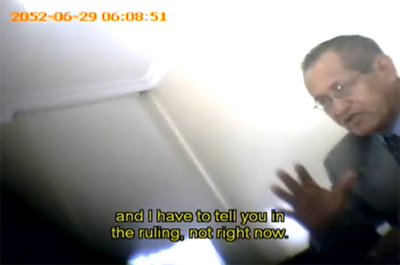
The company instead revealed videos showing a former Chevron contractor named Diego Borja and an American businessman named Wayne Hansen, who appear to be trying fruitlessly to entrap the presiding Judge, Juan Nuñez. Borja and Hansen secretly shot the videos themselves using a spy-camera pen and watch they bought in a catalog.

As The San Francisco Chronicle reports:

The closest the conversation comes to the suggestion of bribery happens when Hansen at one point abruptly asks the judge, "Do you want part of, of my contract?"

The judge responds, "I don't have anything to do with that." Then Hansen appears to correct himself, and says he's talking about money that would go to the government, not the judge.

Borja and Hansen also ask him several times whether he will rule against Chevron, and he repeatedly tells them they must wait for the verdict to find out. These excerpts are from Chevron's transcript.

Hansen: They've been the guilty party for more than many years, right?

Nuñez: You'll see that, sir. What you want to find out is whether it's going to be guilty or not, I'm telling you that I can't tell you that, I'm a judge, and I have to tell you in the ruling, not right now.

The Chronicle article continues:

But as Nuñez prepares to leave the meeting, Hansen asks him again.

Hansen: Oh, no, I, I know clearly how it is, you say, Chevron is the guilty party.

Nuñez: Yes, sir.

A ha! He said yes! He said yes! Gotcha! Predetermination! Corruption! Disqualification!

Except that if you watch the video, Hansen's tortured Spanish statement about Chevron being el culpable - the guilty party- comes as people are shuffling papers and preparing to leave the room. It's not at all clear who the judge is answering or speaking affirmatively to. You can't see the judge when you hear his muffled "yes, sir" and one gets the sense that he's just trying to finish up this meeting that he apparently attended as a favor to an acquaintance.

And that's Chevron's smoking gun -- the judge's single, hardly intelligible, and un-directed "yes, sir" at the end of a meeting at which he has repeatedly said that he cannot predict his verdict.

2009-09-03-nunez.jpg


As the oil giant's PR flacks and executives worked up a sweat fanning the flames of its contrived controversy, the judge defended himself to the Associated Press:
"Never, never, never have I said that it will go against" Chevron, the judge said. "They asked me if a sentence would come out. I said, 'Yes sir, a sentence will come out.' For or against? I have never said anything."

The "bribery plot" Chevron trumpets in its press release has nothing to do with the judge or the court, and instead centers around a separate meeting at which the former Chevron contractor and American businessman discuss payments to a single, excitable man who claims to be connected to Ecuador's ruling party, for access to government contracts for remediation of Chevron's contamination.

In fact, the whole episode raises more troubling questions about Chevron than about the judge or Ecuador's judicial process that the company has spent so much time impugning. 

Chevron denies it had anything to do with soliciting or supporting the apparent sting operation by the former logistics contractor for the company. But Chevron executives have had the video since June, and didn't notify any Ecuadorian or American authorities in advance of its media blitz. Chevron also admits that it paid for the relocation of the former Chevron contractor and his family to the U.S., and has provided other "interim support." Even more suspicious is the fact that Chevron has not allowed reporters covering the story to speak to its former contractor, or the American businessman for whose benefit the meetings were set up.


Steven Donziger, an American lawyer who advises the Amazonian communities in the lawsuit, says it "reeks of a Nixon-style dirty tricks operation and Chevron's fingerprints are all over it."


For years, the company has been losing the argument, so it changes the subject:

"There is no contamination. But if there is contamination, it's not dangerous. And if it is dangerous, it's not ours. And if it's ours, uh, uh... Corruption! Extortion! Defamation! Left-wing tyranny!"


This specious "bribery plot" is Chevron's latest attempt to change the subject and delay the ruling in the case.


Nothing that Chevron presents in the videos alters the underlying facts of the case. 30,000 indigenous people and campesinos living in the Ecuadorian Amazon continue to suffer a severe public health crisis, including an epidemic of cancer, miscarriages, birth defects, and other ailments. The formerly pristine rainforest and Amazon waterways have been poisoned. And it is due to the fact that the oil company operated using substandard practices that were obsolete in order to increase its profit margin by $3 per barrel.


But you don't have to take my word for it.

Go see the new documentary film CRUDE, and judge for yourself. The film looks at the unprecedented legal battle in the Amazon from all sides. Besides raving about how thrilling and gripping it is, reviewers have praised CRUDE for its "balance," "depth," "intellectual honesty," and "even-handed manner."


Unfortunately for Chevron, the truth has a way of bubbling to the surface, like crude in the steamy jungles of Ecuador.


CRUDE opens in New York on September 9th, followed by Los Angeles, San Francisco, and about thirty more cities across the country. Click here to see when it's coming to a theater near you and visit www.ChevronToxico.com to learn more about Amazon Watch's Clean Up Ecuador Campaign
.

Follow Han Shan on Twitter: www.twitter.com/coldmtn


Ecuador vs. Chevron: Do the Videos Implicate the Judge?

Amazing stories out of Ecuador these days - Time Magazine ran the most comprehensive piece we've seen thus far:

Ecuador vs. Chevron: Do the Videos Implicate the Judge?

Thursday, Sep. 03, 2009

Ecuador vs. Chevron: Do the Videos Implicate the Judge?

The lawsuit, the largest of its kind, has lasted 16 years, pitting U.S. oil giant Chevron against residents in the Amazon jungle of Ecuador. They accuse the company of massive petro-contamination of their communities in the late 20th century and seek $27 billion in damages, an amount that has turned nervous corporate heads worldwide.

But now, three months before a verdict is expected to be handed down, Chevron is doing the accusing, filing its own action with Ecuador's prosecutor general. It charges that the Ecuadorian judge in the case should be removed because, it claims, secretly recorded videos captured him admitting that he has already decided that Chevron is guilty — and they allegedly implicate him in a scheme to snag $3 million in bribes from firms hoping to win oil-cleanup contracts after his ruling. Also implicated are high-ranking officials in the government of leftist Ecuadorian President Rafael Correa, an outspoken critic of the U.S. (See pictures of the Amazon contamination that's at the center of the Chevron-Ecuador lawsuit.)

The videos, recorded in June, show Judge Juan Nuñez in meetings with two men, an American and an Ecuadorian, who are allegedly soliciting cleanup deals. Nuñez appears to be merely explaining to them the judicial process involved in the Chevron suit. But at one point he is asked by the American, businessman Wayne Hansen, if Chevron is el culpable — the guilty party. Nuñez, off camera, answers, "Sí, señor" — "Yes, sir." Says Charles James, executive vice president of Chevron, which posted the videos on the Internet on Aug. 31: "No judge who has participated in meetings of the type shown on these tapes could possibly deliver a legitimate decision." (See a video of how fungi can help clean up the petro-contamination in the Amazon.)

It is certainly questionable conduct for Nuñez or any judge to be discussing the landmark case with Hansen and the Ecuadorian, Diego Borja, in such cavalier fashion. In a newspaper interview, Nuñez denied that he told Hansen a predetermined verdict; his supporters say it's unclear in the videos, especially given Hansen's tortured Spanish, what exactly Nuñez is responding to. "This is a total trap on the part of Chevron," Nuñez said in an interview with Ecuadorian network Teleamazonas on Sept. 1. He acknowledged the meetings but said the secret videotaping was a setup, and he insisted that bribes were never discussed.

Although Chevron insists that it had no part in the secret videotaping, it turns out that Borja has worked for the company as a logistics contractor. "This entire episode reeks of a Nixon-style dirty-tricks operation, and Chevron's fingerprints are all over it," says Steven Donziger, a New York lawyer and adviser to the Ecuador plaintiffs. In his TV interview, Nuñez said that if Chevron "sent an employee" — the contractor Borja — that may mean a crime has been committed, since the law forbids him from meeting the parties in the lawsuit.

Nuñez is not present at another meeting in the videos in which men claiming to be influential members of Correa's ruling Alianza País Party lay out a brazen bribery conspiracy. They tell Hansen and Borja that $3 million in payoffs will be required to land a cleanup contract, divided evenly among Nuñez, Correa's office (including, said one of the men, the President's sister) and the plaintiffs. The Chevron complaint also fingered Correa's chief legal adviser, Alexis Mera, in the scheme. At a press conference on Sept. 1, Mera denied being involved and suggested that Chevron was simply trying to divert attention away from a case it knows it will probably lose. "The government won't succumb to these types of provocations," he said.

The Correa administration said Tuesday that while it had thus far seen no evidence of government corruption in the videos, it would investigate the matter "thoroughly, aggressively and fairly." On Wednesday, Ecuadorian justice officials announced they were opening an investigation into the possible government corruption, as well as whether the videotaping had violated laws. In any event, the scandal promises to delay the completion of a trial that has already spanned two decades and two continents. It began in the early 1990s in New York, after settlers and indigenous tribes in the Amazon oil towns of Coca, Lago Agrio and Shushufindi accused Texaco — which was bought by Chevron in 2002 — of recklessly dumping crude and wastewater into their lakes and rivers, seriously damaging the public health and livelihoods of tens of thousands of people. A court-appointed expert estimated the total damage to be a remarkable $27 billion, a figure Chevron says is baseless.

Ironically, Chevron in 2003 requested that the trial be moved to Lago Agrio, believing the conservative Ecuadorian government at the time would be more sympathetic. Indeed, in 1998 the government had declared that Texaco's $40 million cleanup of the sullied Amazon area was satisfactory. But three years later, Correa was elected, and Chevron has complained ever since that his administration has interfered in the case and prodded the judges overseeing it — including Nuñez, who took over last year — toward the plaintiffs.

Chevron executives have been under increasing pressure from shareholders who are fearful of an unfavorable verdict. But the scandal probably has the Correa administration chafing as well, especially since a tainted legal system could compromise its efforts to win most-favored-nation trade status from the U.S. Congress this year.

Either way, says Chevron spokesman Kent Anderson, Nuñez "needs to [recuse himself], and his past rulings need to be annulled." The plaintiff's lawyer, Pablo Fajardo, says the videos are an entrapment of Nuñez and show Chevron attempting to "undermine the trial process so the company can avoid paying a judgment." Says Donziger: "The bottom line [remains] that Chevron is responsible for wrecking Ecuador's rain forest. Nothing Chevron has presented in these videos changes these underlying facts one bit." Chevron's bet is that the videos will at least change international opinion about the court that's weighing those facts.