
Monday, September 21, 2009

"The Chevron Way" by Steven Donziger, posted at Forbes.com

Steven Donziger, one of the primary U.S. lawyers advising the plaintiffs in the lawsuit against Chevron in Ecuador wrote an Op-Ed laying out the case against Chevron. Read on below or after the link:

Forbes.com

Commentary
The Chevron Way
Steven Donziger 09.16.09, 5:30 PM ET

As corporate values statements go, there are few more stirring than the "Chevron Way" espoused by the nation's third largest corporation. Chevron aspires to be "the global energy company most admired for its people, partnership and performance," one that conducts business "in a socially responsible and ethical manner," and "respects the law, supports universal human rights, protects the environment and benefits the communities where we work." That's heady stuff.

Like most corporations today, Chevron has worked hard to learn the lessons of the corporate and social responsibility movement. It spends significant sums of advertising dollars marketing itself as an environmentally sensitive company. No matter how one might feel about oil companies, most entrepreneurs would agree that Chevron has every right to turn a robust profit--as long as it conducts itself in an ethical, legal and responsible manner consistent with its own high-minded rhetoric.

Yet for all the nice words, Chevron's actions--and values--have not always been so responsible. In fact, there is increasing evidence that some of those actions have been downright harmful to the environment and continue to create health risks for thousands of men, woman and children.

Which brings us to Ecuador.

Ecuador is where Chevron currently faces a potentially $27.3 billion financial liability in a long-running legal case over the consequences of Texaco's alleged sub-standard operational practices in the Amazon rainforest. In 2001, Chevron acquired Texaco. And evidence in the lawsuit, plaintiffs say, demonstrates that from 1964 to 1992 Texaco deliberately dumped billions of gallons of toxic waste into Amazon waterways, abandoned more than 900 unlined waste pits, burned millions of cubic meters of noxious gases, and spilled more than 17 million gallons of oil due to pipeline ruptures. A court-appointed special master who conducted a damages assessment found that 173 out of 196 former waste pits operated by Texaco and inspected during the trial are contaminated with petroleum hydrocarbons in violation of Ecuadorian standards (each of Texaco's 356 well sites in Ecuador had multiple waste pits.) One plaintiff's expert said he believes cleaning this mess would be one of the largest decontamination efforts ever attempted.

And the plaintiffs have presented evidence that Texaco acted knowingly. An extraordinary memo dated July 17, 1972, from R.C. Shields, then-head of all Latin American production for Texaco, issued a blunt directive to Texaco's acting manager in Ecuador: "No reports are to be kept on a routine basis, and all previous reports are to be removed from field and division offices and destroyed." Good corporate citizens don't demand that reports documenting environmental damage be destroyed.

In 1992, on the eve of its departure from Ecuador, Texaco quietly hired two outside consulting firms to assess the environmental impact of the company's practices. The audits, which were submitted by Chevron as evidence, found that hydrocarbon contamination "requires remediation at all production facilities and a majority of the drill sites," that "produced water was disposed of into a local creek or river or in some instances directly into the jungle," and that in general, "spills of hydrocarbons and chemicals were not cleaned up." One report found that well site spills occurred at 158 of the 163 assessed sites. It also found, shockingly, that under Texaco's watch, prior to 1990 no spill prevention methods were in place, little maintenance had been done on any of the pits, and there was no groundwater monitoring to assess contamination.

There is also a living record of the contamination from witness testimony: the indigenous people and campesinos of the region, whose children bathed in, played in and drank petroleum-laced water. Evidence has been presented from peer-reviewed academic journals that post-Texaco life on the Amazon saw cancer rates--including childhood leukemia--three times higher than rates in the rest of Ecuador. There is also evidence of elevated rates of miscarriages due to exposure to oil contamination and extensive anecdotal evidence of birth defects. After visiting the region last year, U.S. Rep. James P. McGovern wrote in a letter to President Barack Obama, "As an American citizen, the degradation and contamination left behind by this U.S. company in a poor part of the world made me angry and ashamed."

Douglas Beltman, a former EPA official who serves as a scientific consultant to the affected indigenous groups, summarized the problem succinctly: "Texaco treated Ecuador's Amazon like a garbage dump. Almost everything an oil company could do wrong, Texaco did do wrong."

With the complaints about contamination ignored, I and several other lawyers filed a lawsuit in 1993 on behalf of thousands of affected Ecuadorian citizens. The case was filed in New York federal court, within miles of Texaco's corporate headquarters. The objective was to compel the company responsible for what has been called the "Amazon Chernobyl" to pay for a clean-up. Texaco fought for nine years to move the case to Ecuador, filing 14 sworn affidavits asserting that the country's courts were a fair and adequate forum. In 2002, Texaco--by then, ChevronTexaco (and since renamed, simply, Chevron)--won that battle on the condition that it accept jurisdiction and abide by any ruling in Ecuador.

In May 2003, the Amazon communities re-filed the lawsuit in Ecuador. Over the course of the long trial, more than 60,000 soil and water sampling results culled by the parties and an independent expert have been tested by independent laboratories. These results have then been re-confirmed by yet other independent sources, including a court-appointed special master and U.S. scientists who formerly worked for the EPA and Department of Justice who consult with the local communities. The results show extensive toxic contamination in soils at 100% of Texaco's former well sites.

As the scientific evidence against Chevron mounted, the company went on the attack. It attacked the trial process as unfair--even though it had signed off on the process. It attacked the Ecuadorian judge as corrupt--even though it had filed countless affidavits praising Ecuador's judiciary. It hired lobbyists in Washington to bring pressure on Ecuador President Rafael Correa to quash the case. It promised decades of litigation to prevent a final judgment. In short, Chevron did everything it could to undermine the court system that it had previously praised.

Chevron then tried to shift the blame to Petroecuador, Texaco's consortium partner from 1964 to 1990 and Ecuador's state-owned oil company. Yet records in evidence show that Texaco was the sole operator in Ecuador--exclusively designing, installing and running the massive operation. Internal company documents from the discovery process demonstrate Texaco made all significant production and business decisions, even down to how much could be spent to purchase a file cabinet. It is customary in the oil industry for the operator of oil fields to bear 100% of the responsibility for environmental contamination--and to be compensated for the additional risk.

Chevron also claims it is not liable because in 1995 it paid $40 million to "clean" a portion of the well sites and waste pits in exchange for a release from liability from Ecuador's government. Interestingly, Chevron received the release before remediating a single site. Evidence at trial submitted by the plaintiffs demonstrates that Texaco's purported clean-up ignored the contaminated groundwater, rivers and streams, and consisted primarily of dumping dirt over waste pits without adequately cleaning out the toxins--akin to treating skin cancer with make-up. Evidence submitted by the plaintiffs shows that one well site, Lago Agrio 2, today has levels of TPH 3,250 times higher than allowed in the U.S. and 325 times higher than allowed under Ecuadorian law even though it had been certified by Texaco as "remediated" to secure its release. Worse, two former Texaco lawyers (now Chevron employees) and seven former Ecuadorian government officials are under criminal indictment in Ecuador for allegedly lying about the clean-up. Chevron announced this sad fact in its own press release.

On Forbes.com recently, writer Silvia Santacruz rolled out the latest of Chevron's counter-attacks: that Ecuadorian President Rafael Correa has publicly supported the plaintiffs and made a fair trial impossible; that plaintiff attorneys have made a career out of pursuing Chevron; and that this is really just a case of radical environmentalism at work. What Chevron doesn't say is that it has been afforded more due process rights than probably any defendant in the history of environmental litigation. The company has submitted more than 100,000 pages of evidence and more than 50,000 chemical sampling results to the court, most of which were found by the special master to corroborate the allegations of the plaintiffs that the company's former well sites pose a high risk to human health. The indigenous communities already have waited 16 years for a resolution of their claims.

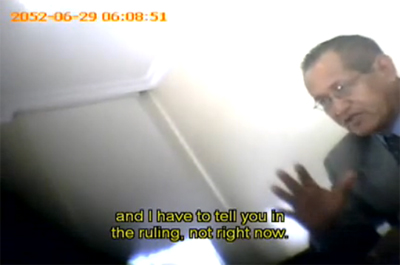
At the end of August, the case took its strangest turn yet, when Chevron claimed it had video footage implicating the Ecuadoran judge presiding over the trial in a "$3 million bribery scheme." "Except," as Han Shan editorialized on the Huffington Post, "it didn't. The company revealed videos showing a former Chevron contractor named Diego Borja and an American businessman named Wayne Hansen, who appear to be trying fruitlessly to entrap the presiding judge, Juan Nunez." As the Financial Times pointed out in a Sept. 1 article, "The judge refuses several times on the tape to reveal the verdict, before saying, 'Yes sir,' when asked if he will find Chevron guilty. Nonetheless, the video begs the question whether Judge Nunez understood what he was being asked." The Ecuadoran government says it will investigate, and Nunez has recused himself from the case for any appearance of impropriety.

But, as the Los Angeles Times put it in an editorial, Ecuador's government "should probe not just the judge's actions but those of Chevron." While claiming to have no role in the sting operation, Chevron admits it paid for the relocation of Borja and his family to the U.S., and provided support. It has also admitted that it had the videotape in its possession since June, but didn't notify American or Ecuadoran officials before its media blitz. And, equally suspicious, Chevron has not allowed reporters covering the story to speak with either Borja or Hansen about the incident--which, in Shan's words, "raises more troubling questions about Chevron than about the judge or Ecuador's judicial process."

In the meantime, the U.S. Supreme Court and U.S. federal trial courts have dealt Chevron five consecutive defeats in the company's attempt to shift the liability to Petroecuador. New York Attorney General Andrew Cuomo--at the request of several Chevron shareholders, including the state's pension fund--has launched an investigation to determine whether Chevron is misleading the financial markets about the risk it faces in Ecuador. And an award-winning independent documentary by Joe Berlinger, Crude, will land in theaters in September.

The humanitarian crisis could be quickly addressed if Chevron chose to clean up its mess, as any responsible company would do. Instead, it has decided to violate the values in the "Chevron Way" and reach into its deep pockets, to litigate indefinitely because it is cheaper than funding a clean-up. It has told shareholders it will not pay even if found guilty--a brazen sign of disrespect for the law that not only violates Chevron's previous obligation to a U.S. court, but also damages the image of the United States throughout Latin America. And all the while, Chevron is running ads singing the praises of its environmental and human rights practices.

Until Chevron addresses the consequences of Texaco's rogue behavior in Ecuador, besmirching its reputation and giving American companies a bad name will be the real meaning of the Chevron Way.

Steven Donziger, a New York lawyer, represents Ecuadorian plaintiffs in their suit against Chevron.
Thursday, September 3, 2009

Han Shan: Chevron's 'Dirty Tricks Operation' in the Amazon

Amazing post today on Huffington Post by Han Shan - linked and copied below

Han Shan: Chevron's 'Dirty Tricks Operation' in the Amazon

If you can't win the argument, change the subject.

That seems to be oil giant Chevron's strategy, as it battles a lawsuit for massive contamination of the Ecuadorian Amazon.


After 16 years in litigation, a monumental environmental lawsuit by 30,000 indigenous people and campesinos against Chevron appears to be drawing to a close. The oil company has publicly said that it expects to be found liable for up to $27 billion in damages for what has become known as the 'Amazon Chernobyl.' And in less than a week, a high-profile documentary film about the case- acclaimed filmmaker Joe Berlinger's CRUDE- comes out in U.S theaters.

And so, time to change the subject. Ready for Chevron's 'September Surprise?'


On Monday, Chevron breathlessly declared that it had video footage implicating the judge presiding over the trial in a "$3 million bribery scheme."


Except it didn't.


The company instead revealed videos showing a former Chevron contractor named Diego Borja and an American businessman named Wayne Hansen, who appear to be trying fruitlessly to entrap the presiding Judge, Juan Nuñez. Borja and Hansen secretly shot the videos themselves using a spy-camera pen and watch they bought in a catalog.

As The San Francisco Chronicle reports:

The closest the conversation comes to the suggestion of bribery happens when Hansen at one point abruptly asks the judge, "Do you want part of, of my contract?"

The judge responds, "I don't have anything to do with that." Then Hansen appears to correct himself, and says he's talking about money that would go to the government, not the judge.

Borja and Hansen also ask him several times whether he will rule against Chevron, and he repeatedly tells them they must wait for the verdict to find out. These excerpts are from Chevron's transcript.

Hansen: They've been the guilty party for more than many years, right?

Nuñez: You'll see that, sir. What you want to find out is whether it's going to be guilty or not, I'm telling you that I can't tell you that, I'm a judge, and I have to tell you in the ruling, not right now.

The Chronicle article continues:

But as Nuñez prepares to leave the meeting, Hansen asks him again.

Hansen: Oh, no, I, I know clearly how it is, you say, Chevron is the guilty party.

Nuñez: Yes, sir.

A ha! He said yes! He said yes! Gotcha! Predetermination! Corruption! Disqualification!

Except that if you watch the video, Hansen's tortured Spanish statement about Chevron being el culpable - the guilty party- comes as people are shuffling papers and preparing to leave the room. It's not at all clear who the judge is answering or speaking affirmatively to. You can't see the judge when you hear his muffled "yes, sir" and one gets the sense that he's just trying to finish up this meeting that he apparently attended as a favor to an acquaintance.

And that's Chevron's smoking gun -- the judge's single, hardly intelligible, and un-directed "yes, sir" at the end of a meeting at which he has repeatedly said that he cannot predict his verdict.

2009-09-03-nunez.jpg


As the oil giant's PR flacks and executives worked up a sweat fanning the flames of its contrived controversy, the judge defended himself to the Associated Press:
"Never, never, never have I said that it will go against" Chevron, the judge said. "They asked me if a sentence would come out. I said, 'Yes sir, a sentence will come out.' For or against? I have never said anything."

The "bribery plot" Chevron trumpets in its press release has nothing to do with the judge or the court, and instead centers around a separate meeting at which the former Chevron contractor and American businessman discuss payments to a single, excitable man who claims to be connected to Ecuador's ruling party, for access to government contracts for remediation of Chevron's contamination.

In fact, the whole episode raises more troubling questions about Chevron than about the judge or Ecuador's judicial process that the company has spent so much time impugning. 

Chevron denies it had anything to do with soliciting or supporting the apparent sting operation by the former logistics contractor for the company. But Chevron executives have had the video since June, and didn't notify any Ecuadorian or American authorities in advance of its media blitz. Chevron also admits that it paid for the relocation of the former Chevron contractor and his family to the U.S., and has provided other "interim support." Even more suspicious is the fact that Chevron has not allowed reporters covering the story to speak to its former contractor, or the American businessman for whose benefit the meetings were set up.


Steven Donziger, an American lawyer who advises the Amazonian communities in the lawsuit, says it "reeks of a Nixon-style dirty tricks operation and Chevron's fingerprints are all over it."


For years, the company has been losing the argument, so it changes the subject:

"There is no contamination. But if there is contamination, it's not dangerous. And if it is dangerous, it's not ours. And if it's ours, uh, uh... Corruption! Extortion! Defamation! Left-wing tyranny!"


This specious "bribery plot" is Chevron's latest attempt to change the subject and delay the ruling in the case.


Nothing that Chevron presents in the videos alters the underlying facts of the case. 30,000 indigenous people and campesinos living in the Ecuadorian Amazon continue to suffer a severe public health crisis, including an epidemic of cancer, miscarriages, birth defects, and other ailments. The formerly pristine rainforest and Amazon waterways have been poisoned. And it is due to the fact that the oil company operated using substandard practices that were obsolete in order to increase its profit margin by $3 per barrel.


But you don't have to take my word for it.

Go see the new documentary film CRUDE, and judge for yourself. The film looks at the unprecedented legal battle in the Amazon from all sides. Besides raving about how thrilling and gripping it is, reviewers have praised CRUDE for its "balance," "depth," "intellectual honesty," and "even-handed manner."


Unfortunately for Chevron, the truth has a way of bubbling to the surface, like crude in the steamy jungles of Ecuador.


CRUDE opens in New York on September 9th, followed by Los Angeles, San Francisco, and about thirty more cities across the country. Click here to see when it's coming to a theater near you and visit www.ChevronToxico.com to learn more about Amazon Watch's Clean Up Ecuador Campaign
.

Follow Han Shan on Twitter: www.twitter.com/coldmtn


Ecuador vs. Chevron: Do the Videos Implicate the Judge?

Amazing stories out of Ecuador these days - Time Magazine ran the most comprehensive piece we've seen thus far:

Ecuador vs. Chevron: Do the Videos Implicate the Judge?

Thursday, Sep. 03, 2009

Ecuador vs. Chevron: Do the Videos Implicate the Judge?

The lawsuit, the largest of its kind, has lasted 16 years, pitting U.S. oil giant Chevron against residents in the Amazon jungle of Ecuador. They accuse the company of massive petro-contamination of their communities in the late 20th century and seek $27 billion in damages, an amount that has turned nervous corporate heads worldwide.

But now, three months before a verdict is expected to be handed down, Chevron is doing the accusing, filing its own action with Ecuador's prosecutor general. It charges that the Ecuadorian judge in the case should be removed because, it claims, secretly recorded videos captured him admitting that he has already decided that Chevron is guilty — and they allegedly implicate him in a scheme to snag $3 million in bribes from firms hoping to win oil-cleanup contracts after his ruling. Also implicated are high-ranking officials in the government of leftist Ecuadorian President Rafael Correa, an outspoken critic of the U.S. (See pictures of the Amazon contamination that's at the center of the Chevron-Ecuador lawsuit.)

The videos, recorded in June, show Judge Juan Nuñez in meetings with two men, an American and an Ecuadorian, who are allegedly soliciting cleanup deals. Nuñez appears to be merely explaining to them the judicial process involved in the Chevron suit. But at one point he is asked by the American, businessman Wayne Hansen, if Chevron is el culpable — the guilty party. Nuñez, off camera, answers, "Sí, señor" — "Yes, sir." Says Charles James, executive vice president of Chevron, which posted the videos on the Internet on Aug. 31: "No judge who has participated in meetings of the type shown on these tapes could possibly deliver a legitimate decision." (See a video of how fungi can help clean up the petro-contamination in the Amazon.)

It is certainly questionable conduct for Nuñez or any judge to be discussing the landmark case with Hansen and the Ecuadorian, Diego Borja, in such cavalier fashion. In a newspaper interview, Nuñez denied that he told Hansen a predetermined verdict; his supporters say it's unclear in the videos, especially given Hansen's tortured Spanish, what exactly Nuñez is responding to. "This is a total trap on the part of Chevron," Nuñez said in an interview with Ecuadorian network Teleamazonas on Sept. 1. He acknowledged the meetings but said the secret videotaping was a setup, and he insisted that bribes were never discussed.

Although Chevron insists that it had no part in the secret videotaping, it turns out that Borja has worked for the company as a logistics contractor. "This entire episode reeks of a Nixon-style dirty-tricks operation, and Chevron's fingerprints are all over it," says Steven Donziger, a New York lawyer and adviser to the Ecuador plaintiffs. In his TV interview, Nuñez said that if Chevron "sent an employee" — the contractor Borja — that may mean a crime has been committed, since the law forbids him from meeting the parties in the lawsuit.

Nuñez is not present at another meeting in the videos in which men claiming to be influential members of Correa's ruling Alianza País Party lay out a brazen bribery conspiracy. They tell Hansen and Borja that $3 million in payoffs will be required to land a cleanup contract, divided evenly among Nuñez, Correa's office (including, said one of the men, the President's sister) and the plaintiffs. The Chevron complaint also fingered Correa's chief legal adviser, Alexis Mera, in the scheme. At a press conference on Sept. 1, Mera denied being involved and suggested that Chevron was simply trying to divert attention away from a case it knows it will probably lose. "The government won't succumb to these types of provocations," he said.

The Correa administration said Tuesday that while it had thus far seen no evidence of government corruption in the videos, it would investigate the matter "thoroughly, aggressively and fairly." On Wednesday, Ecuadorian justice officials announced they were opening an investigation into the possible government corruption, as well as whether the videotaping had violated laws. In any event, the scandal promises to delay the completion of a trial that has already spanned two decades and two continents. It began in the early 1990s in New York, after settlers and indigenous tribes in the Amazon oil towns of Coca, Lago Agrio and Shushufindi accused Texaco — which was bought by Chevron in 2002 — of recklessly dumping crude and wastewater into their lakes and rivers, seriously damaging the public health and livelihoods of tens of thousands of people. A court-appointed expert estimated the total damage to be a remarkable $27 billion, a figure Chevron says is baseless.

Ironically, Chevron in 2003 requested that the trial be moved to Lago Agrio, believing the conservative Ecuadorian government at the time would be more sympathetic. Indeed, in 1998 the government had declared that Texaco's $40 million cleanup of the sullied Amazon area was satisfactory. But three years later, Correa was elected, and Chevron has complained ever since that his administration has interfered in the case and prodded the judges overseeing it — including Nuñez, who took over last year — toward the plaintiffs.

Chevron executives have been under increasing pressure from shareholders who are fearful of an unfavorable verdict. But the scandal probably has the Correa administration chafing as well, especially since a tainted legal system could compromise its efforts to win most-favored-nation trade status from the U.S. Congress this year.

Either way, says Chevron spokesman Kent Anderson, Nuñez "needs to [recuse himself], and his past rulings need to be annulled." The plaintiff's lawyer, Pablo Fajardo, says the videos are an entrapment of Nuñez and show Chevron attempting to "undermine the trial process so the company can avoid paying a judgment." Says Donziger: "The bottom line [remains] that Chevron is responsible for wrecking Ecuador's rain forest. Nothing Chevron has presented in these videos changes these underlying facts one bit." Chevron's bet is that the videos will at least change international opinion about the court that's weighing those facts.

Thursday, August 13, 2009

Jim Hightower: CHEVRON SOILS ITSELF


Hightower notes:
"For a quarter of a century, Chevron's Texaco subsidiary crudely and willfully contaminated the land, water and people of this region with an oil extraction process so crude, careless, and deadly that it still stands as one of the world's grossest examples of corporate insensitivity."

Powerful stuff.

Wednesday, August 12, 2009

Chevron Not Even Buying The Lies Chevron Is Selling.

(This was originally posted by Nick over at www.chevroninecuador.com – interesting, so cross-posted here.)


Chevron's Ecuador claims rejected by US courts for 5th time in two years.

Well is seems Chevron's brand new chief in-house Lawyer Hew Pate is really going to have his work cut out for him. Chevron must be telling him something like "hey buddy, we've got nowhere to go but up. Good luck".

Today, in yet another instance where Chevron has quietly tucked it’s tail between its legs and went h,ome the 5th lawsuit Chevron has brought to US federal court has been tossed out. Following last months swift rejection by the US Supreme Court, and with little fanfare, Chevron withdrew it’s claim that they had been released by the Ecuadorian government of any liability for the dumping of billions of gallons of toxic waste water and crude oil.

Chevron claims that they had remediated a small portion of the 916 waste pits it built in Ecuador. Yet, according to a Special Master report from the Ecuador trial the so-called remediated sites are extensively contaminated, containing cancer-causing toxins at levels hundreds of times higher than U.S. and Ecuadorian law allows.

Chevron has long claimed that their remediation process has released them of all remaining liabilities. Well, their own decision to withdraw this claim from federal court begs the question... Does Chevron even believe the lies coming from Chevron these days?

Thursday, June 18, 2009

Chevron’s New Shills

In a sign of frustration over their inability to convince any journalists with a semblance of independence or journalistic integrity to publish their talking points, Chevron has turned to paying faux journalists and bloggers to parrot the company's talking points and to do the company's dirty work in lobbing baseless accusations against the people bringing a landmark environmental lawsuit against the company.

In yet another instance of the company treating it's $27 billion legal liability in Ecuador as an image problem to be managed, rather than as an environmental and human rights crisis to be dealt with, Chevron has taken extreme measures over the recent past: hiring disgraced former-CNN anchor Gene Randall to put together a high-priced faux-news story that tries to fool viewers into thinking it's an independent news video, and paying for an all-expense paid trip for bloggers (including Carter Wood of Shopfloor.com, Bob McCarty of BobMcCartyWrites.com, Gail Tverberg of theoildrum.com, and Roger Alford of opinojuris.com) to Ecuador to participate in the company's propaganda tour.

[Update/Editor's Note: In the interest of clarity and fairness, while Roger Alford attended a trip paid for by Chevron, he has not written anything about this lawsuit, or otherwise opined on the issue.]

The result of Chevron's efforts? A number of posts that purport to be "news" that simply parrot Chevron's P.R. messages at the expense of any journalistic integrity that the "reporters" may have had.

Already Gene Randall, who traded on his familiarity as a former CNN anchor to create a fraudulent report for Chevron, has been publicly reprimanded in the New York Times, the Columbia Journalism Review, and On The Media, among other prestigious journalism publications. From interviews published in On The Media it appears that Randall has already resigned himself to counting his silver pieces to justify his loss of any public credibility that he may have had: "I didn't choose to leave CNN," Randall said, "and now that I have, I have to make a living somehow. So I offer my ability to use 'journalistic techniques' to clients who need to present their messages."

But perhaps more egregious than Randall's willingness to trade on his former association with CNN as part of Chevron's effort to manipulate public opinion, is the wholesale sale of their credibility that has occurred in the blogs over the past few weeks. The company has admitted to taking several bloggers on an all-expense paid trip to Ecuador to indoctrinate them in the company's messaging on the Ecuadorian lawsuit. The bloggers returned from the propaganda trip armed with a wealth of baseless accusations that they have lobbed at the indigenous people of Ecuador and the lawyers working with them. In true blogger fashion, almost none of these internet "journalists" bothered to consult with anyone other than Chevron before they started making their allegations. Instead, they simply sold whatever credibility and integrity they may have had to Chevron in return for a nice trip to Ecuador (or in McCarty's case – since he didn't actually go when he had to cancel, just the promise of a trip).

It will be interesting to see if the loss of integrity and credibility is worth the free flight that Chevron provided (hey – it might have even been first class…after all, the company did make $23.8 billion in profit last year).

Monday, June 15, 2009

Chevron Praised Ecuador’s Courts for years and years…

until the company stood to profit by trashing them.

It turns out that long before Chevron picked up their new theme that "Ecuador's courts are biased" (no doubt a message that was refined in countless focus groups before Chevron's P.R. firms started pushing it out to you, loyal reader) the company spent years praising the courts, in an attempt to get the case transferred down to Ecuador. Turns out that Chevron loved the Ecuadorian courts - loved them just until evidence started being filed that showed that Chevron was responsible for the environmental and humanitarian disaster in the region. As soon as that happened, Chevron started their current messaging that Ecuadorian courts are corrupt and biased. Hmm – seems convenient for Chevron that Ecuadorian courts turned biased just as the evidence started revealing the depths of the environmental and humanitarian crime committed in the region.

But read for yourself – we're posting here the 14 sworn affidavits that Texaco (which Chevron merged with in 2001) filed in U.S. Federal Court praising the Ecuadorian courts as fair and unbiased. You can see for yourself exactly what Texaco (and now Chevron) thought about the Ecuadorian judiciary - right up until the company had a $27 billion interest in trashing them.

This is Chevron's M.O. - do anything, and say anything, you have to in order to avoid having to take responsibility for your actions.

Friday, June 12, 2009

NY Times highlights “Crude” at Human Rights Watch; Film Premiering Tomorrow

"Crude" – the documentary which exposes Chevron's toxic legacy in Ecuador – is premiering tomorrow at the Human Rights Watch International Film Festival, at the Lincoln Center theatre. And in advance of the screening, the New York Times published a glowing review of the film today: http://www.nytimes.com/2009/06/12/movies/12rights.html. You can read below:

Film

From Ecuador to Rwanda: Portraits of Global Threats and Struggles

By STEPHEN HOLDEN

Lessons in how the world works and portraits of the never-ending struggles in places around the globe where power is challenged by populist resistance: such matters are a concern of the Human Rights Watch International Film Festival, which this year celebrates its 20th anniversary.

Rarely have such conflicts been examined with the depth and power of Joe Berlinger's documentary "Crude." Three years in the making, the film looks at all sides of the so-called Amazon Chernobyl case, a multibillion-dollar lawsuit that pits 30,000 Ecuadorean rainforest dwellers against Chevron.

In the film, which has its New York premiere on Saturday, the plaintiffs allege that three decades of pollution from petrochemical sludge dumped by Texaco, which merged with Chevron in 2001, have created a dead zone the size of Rhode Island and resulted in skyrocketing rates of birth defects and cancer, especially leukemia. Chevron has fought the lawsuit, claiming the case was cooked up by greedy "environmental con men" and blames the state-owned Petroecuador, which took over the country's oil production in 1990.

As much as "Crude" sympathizes with the plaintiffs (the film's hero, Pablo Fajardo, their lead lawyer, once worked in the oil fields), it isn't a starkly black-and-white David and Goliath story. We hear from scientists, lawyers for both sides, Ecuadorean judges, celebrity activists (Trudie Styler and Sting) and President Rafael Correa of Ecuador, who has sided with the plaintiffs in a case that may drag on for decades. These real characters and events play out on the screen like a sprawling legal thriller.

This film is timely – in the past few weeks Chevron's problem in Ecuador has become a huge issue for the company. Chevron has been faced with concerns from shareholders, activists, and the general public, as CEO David O'Reilly has been faced with constant questions about Chevron's human rights policies: more than $37 billion worth of Chevron stock defied O'Reilly and voted for a resolution calling for a comprehensive human rights, NY Attorney General Andrew Cuomo opened an investigation into potential violations of securities laws, a slate of media stories exposing the company's deep exposure to the potential Ecuador liability, and a rising tide of concerns about a lack of independent oversight from the Chevron Board of Directors.

With this level of interest in Chevron's problems, we expect that Crude will open to a ton of interest from people clamoring to get an inside view of what is really happening with Chevron's Ecuadorian legacy.

Tuesday, June 9, 2009

Carie Ellis: What Chevron has to learn from "Leave it to Beaver"

Very interesting blog from Carrie Ellis over at Chem.Info. Take a look at: Amazon Chernobyl

or below, where we've copied the blog:


Chevron Digging Its Own Waste Pit

by Carrie Ellis, Editor, Chem.Info

Carrie_Ellis_Editor_Chem_Infor

Only something catastrophic could come from a corporation with a moniker that can be easily manipulated into such URLs as www.texacotoxico.org and www.chevrontoxico.com as intimated by the Amazon Defense Coalition and Amazon Watch.


I don’t know how many of you have been following what some environmentalists are calling Amazon Chernobyl, but one word keeps reverberating in my head — ridiculous. Maybe even unbelievable. Actually, I could probably go as far as audacious.


Ditching more than 18 billion gallons of toxic waste into rainforest water reserves. Walking out on more than 900 waste pits. An estimated excess of 1,401 cancer deaths. Escalating childhood leukemia. An abnormal number of miscarriages. Increasing instances of birth defects amongst mothers exposed to contaminated water. Perhaps even killing off entire indigenous groups.


These environmental atrocities are coming to fruition at a time when companies are being lauded for going green, yet this oil giant still insists on playing the Ecuadorian bully — with a past that continues to prove it’s pockmarked with oil waste dumping and other major environmental transgressions.


If you find yourself lacking (or me a bit over-the-top), however, in the wealth of resources recording this landmark case, please visit the following links for more information on the noxious storm gathering over not only the Amazon, but Chevron, too:

What I find more gruesome than Chevron’s lack of self-responsibility is that it has smeared this already ugly, historically expensive environmental case with Eddie Haskell-like PR and marketing schemes, including a junk documentary to thwart bad press from “60 Minutes” and other thinly veiled ploys, designed to foil shareholders and drum up public support.


"I have makeup on, and there's naturally occurring oil on my face. Doesn't mean that I'm going to get sick from it," Chevron in-house lawyer and spokesperson Sylvia Garrigo said defensively during her “60 Minutes” interview.


OK, forget gruesome. It’s too leading and perhaps pejorative. Let’s go with strategically confused … Maybe even sadistically delusional. I feel like this industry giant is injuring a reputation more than anything. (Well, I guess not as much as its dignity.) Didn’t “Leave It To Beaver” always teach us that you may as well own up to your mistakes rather than try to chicken-scratch ‘em like Haskell? To be a standup guy and admit wrongdoing when you’re inevitably caught? Must we return to the teacup episode?


Chevron is elbows-deep in the most expensive — around $27 billion — environmental lawsuit this world has ever known. Yet it seems like the more negative attention that is brought on the company, the dirtier it plays and the more conniving its schemes. The company is even under public investigation for fraud. Then repeat.


One of the more recent faux pas was when Chevron enlisted Samuel Armacost — a board of directors member with $3.1 million invested — to disprove the incriminating data amassed by court-appointed scientists in Ecuador. The company financed a so-called independent study of cancer rates in the affected areas to discredit these scientists.


Turns out, the study fudged numbers by taking into account only those cancer victims who had death certificates. With an admittedly limited knowledge of information sharing amongst rainforest inhabitants, I never pictured indigenous groups to be big on paper trails, especially considering most have never had the opportunity to see a doctor. The simple fact that Chevron appointed Armacost further undermines its integrity, while reducing our willingness to believe its other claims.


It’s not that I don’t know most of the articles I referenced also come from parties with a vested interest in the case at hand. It’s not that I want things to be the way they are either. It’s just that these environmental groups back up their argument, while big business continues to flounder. If I were accused of false reporting or grammatical murder, I’d take a moment to reflect. Then, upon not being able to validate my ineptitude, I’d print a retraction or devise how to otherwise make amends.


Mind you, I realize much more is at stake for Chevron than its name (namely, a lot of money), but where does the oil giant envision itself if it even were to sidestep this well-documented historical case? The company would inevitably remain tainted with a loss of both social and environmental credibility. Or maybe just respect.


My words of advice: Play nice and take responsibility for your actions before you alienate everyone. While your biggest proponents may initially grimace, your biggest opponents must admit that at least you’re doing your part to fix any oversights. With this upfront approach, you may be able to not only avoid incurring lawsuits in the first place, but also a bad name and a fraudulent reputation.

Chevron CEO a sociopath?

Mike Papantonio, an extremely accomplished attorney who is not, to our knowledge, involved in any of the lawsuits against Chevron, published an interesting view of Chevron's response to the "True Cost of Chevron" on the Huffington Post. Take a look below or at: http://www.huffingtonpost.com/mike-papantonio/chevron-shareholders-igno_b_213091.html.

Chevron Shareholders Ignore Company's Abuses

A textbook sociopath is difficult to pick out of a crowd unless you have special training as a shrink. So just imagine how difficult it becomes when that sociopath is a corporation that spends billions of dollars on ad campaigns that hide their most malignant qualities. Money spent in the right way can easily mask that corporation's reduced ability to feel empathy for other people. It can hide irresponsible behavior and lack of remorse. It can disguise the patterns of deceitfulness that help define a sociopath's personality disorder.

Chevron had profits in 2008 of $24 billion. They have enough money to create slick commercials where they overwhelm us with images of blue skies over pristine looking waterways. Children are usually playing at the edge of that waterway with a family that stepped right out of Disney casting. The gentle voice in the background tells us that Chevron cares immensely about our health and our planet. That voice tells us that Chevron is frantically looking for solar, wind, and hydrogen alternatives to fossil fuel. But here is the reality check. Two weeks ago a coalition of the most prestigious human rights activists in the world handed Chevron a chilling report entitled, "The True Cost of Chevron." Reuters reported that the CEO at Chevron said the report was insulting and should be thrown in the trash. I agree that it was insulting for any corporation that does not want to be characterized as a brutal global thug. But David O'Reilly, Chevron's C.E.O., should not be too quick to throw this document in the trash.

It is a report that tells stories about human rights abuses in places like Nigeria and Burma, where Chevron has been accused of promoting military violence that involves beatings and kidnappings of community activists. Those activists object to oil extraction systems that destroy waterways, ecosystems, and breathable air. As you read this column, court hearings in Ecuador are taking place where Chevron stands potentially responsible for $25 billion in damages to Ecuador's waterways and aquifers.

Before Mr. O'Reilly throws this report into a trashcan, he should tell shareholders why Chevron was accused of providing influence gifts to U.S. Department of Interior employees last year. That is the scandal where government staff accepted thousands of dollars in influence gifts, and engaged in sex and used cocaine with oil industry representatives. That was the very agency that was supposed to police Chevron's conduct on U.S. soil. But there's more. While Chevron is selling their green alternative image in multi-million dollar ads, the truth is that they are spending less than 3% of their almost limitless capital on developing green alternative energy. But why worry about alternative energy when they run an oligopoly that has swallowed up independent refineries and retail stations to the point that Chevron controls how much oil gets refined and how much fuel gets to pumps? Price manipulation is always just one fuel crisis away.

Prognosis for sociopaths is never good because they are too quick to deny that they have a serious problem. But I'm sure any well-trained shrink would at least advise Chevron to take a first step. That begins with reading the report.

Sunday, May 31, 2009

Alternate Annual Report on Chevron’s Human Rights Problem Around the World

Apparently we're not the only ones paying attention to Chevron's human rights problems. An "alternate annual report" has been posted about the impact of Chevron's operations on communities worldwide. We linked to it in an earlier post, but wanted to make it more easily availabe to you. Take a look after the jump: True Cost of Chevron.

Wednesday, May 27, 2009

Thin Green Line: “What’s Not In Chevron’s Annual Report”

Great blog by Cameron Scott looking at another way to look at Chevron's annual report today at the "Thin Green Line" blog on SF Gate today: http://www.sfgate.com/cgi-bin/blogs/green/detail?&entry_id=40674

Reprinting here:

What's not in Chevron's annual report


People with strong ideological perspectives are often outraged by media coverage of their pet issues. When both sides are mad, you know you're doing something right. But how often do you hear corporations furious about they way they are covered in the business section? The section seems to lend itself to favor-currying and soft-shoeing.

In the lead-up to Chevron's annual shareholders meeting tomorrow in San Ramon, the company landed a puff piece on KGO focusing on its efforts to decrease its water usage. No mention of the Amazon controversy, and no mention of outside pressure on Chevron, EBMUD's largest water user.

I'm disappointed to say that a Chronicle
interview with the company's top lawyer also softballs the issues, while giving Chevron the opportunity to present its side of the story with no opportunity for response from the company's many critics. [Update: Chron editors tell me there will be more coverage of Chevron later in the week.]

Well, Chevron's opponents, including San Francisco's Amazon Watch, have taken matters into their own hands, releasing an alternate annual report that presents the externalities not listed in the company's balance sheet, which shows a record profit of $24 billion, making the company the second most profitable in the United States.

Did you know that Chevron's Richmond refinery was built in 1902 and emitted 100,000 pounds of toxic waste in 2007, consisting of no less than 38 toxic substances? The EPA ranks it as one of the worst refineries in the nation. With 17,000 people living within 3 miles from the plant, you'd think the San Ramon-based company would take local heat from more than just a couple dozen activists.

Chevron has sought to brand itself an "energy" company, one eagerly pursuing alternatives to petroleum. Its aggressive "Will You Join Us?" ad campaign asked regular folks to reduce their energy consumption, suggesting that Chevron was doing the same. In actuality, the company spent less than 3 percent of its whopping capital and exploratory expenditures on alternative energy. And it has refused to offer better reporting on its greenhouse gas emissions, despite strong shareholder support for it. (The aggressive, and misleading, ad campaign seems to have ired the report's researchers as well: The report is decorated by numerous parodies, and some have been wheat-pasted around town.)

It's a very well researched report, written by the scholar Antonia Juhasz, clearly divided into regional issues, and it's a much needed counterbalance to the friendly coverage Chevron is otherwise getting. (Juhasz was interviewed on Democracy Now this morning.)

For information on protesting the shareholder meeting early tomorrow morning, click here.

“Chevron Botching Ecuador Case”

The Amazon Defense Coalition put out a press release today calling attention to an oil industry publication reporting about Chevron's Ecuador problem. Take a look:

Chevron Botching Ecuador Case, Says Influential Report

$27 Billion Liability in Ecuador "Poorly Handled" By Chevron's Top Management, Analyst Tells Leading Trade Publication


New York, NY (May 27, 2009) – Platt's Oilgram News, the leading trade publication for the oil industry, is reporting that "momentum seems to be growing against Chevron" in the long-running environmental case brought by Amazon communities in Ecuador that could lead to a $27 billion judgment later this year.

The article, published on Tuesday under the headline "Concerns Grow in Chevron-Ecuador Suit", quotes a leading oil industry analyst, Fadel Gheit, as saying the Ecuador case "is a mess in the ground and in public opinion" and has been "very poorly handled" by Chevron. The $27 billion liability is expected to be a major topic today at Chevron's annual meeting, with attention focused on how Chevron's Board of Directors had not independently vetted management's handling of the matter.

The lawsuit, being held in Ecuador at Chevron's request, will determine if Chevron will be forced to pay for a clean-up of the more than 18 billion gallons of toxic waste dumped by Texaco (now Chevron) when it operated an oil concession in the Amazon from 1964 to 1990. A team of court-appointed experts has assessed damages at up to $27.3 billion and a decision is expected later this year.

Several scientific experts consider the disaster to be the worst oil-related contamination on the planet. A team of U.S.-based reviewers found that the damages number is consistent with the cost of other large environmental clean-ups around the world.

Gheit, who works for Oppenheimer, was quoted in reference to Chevron's Ecuador liability as saying: "I think the longer it lingers the more it will cost. I would settle and cut my losses. Time is not on their side. The sooner they resolve it the better off shareholders are. I don't think it will cost $27 billion, but [it] will certainly cost a hell of a lot more than $1.8 billion" that Chevron has set aside for liabilities.


The article also quoted Barclay's Capital analyst Paul Cheng as saying, in reference to the Chevron liability, that "we would expect that any negative ruling [in Ecuador] would be damaging to the stock's near-term performance, and we would be an aggressive buyer to take advantage of any weakness."

Platts Oilgram News is widely recognized as the standard publication chronicling the oil and gas energy sector and its published rates are used as a benchmark within the industry. The article reported on concerns about Chevron being raised by the New York attorney general and public and private funds.

The article quotes a letter sent to Chevron by New York Attorney General Andrew Cuomo saying "this office has broad authority to investigate and pursue allegations of financial fraud and material misstatements in connection with publicly traded companies." Cuomo said he was looking into "Chevron's characterization of available legal defenses" and asked Chevron to estimate "possible damages if found liable … [and] what if any reserves have been established in contemplation of such damages being assessed against Chevron."

The Cuomo investigation is being brought under New York's Martin Act, which allows for both civil and criminal liability for fraud. Several New York shareholders had requested the probe to determine if Chevron is complying with securities laws.

Leaders from Ecuador's Amazon region are expected to attend the shareholder's meeting today and confront Chevron CEO David O'Reilly over the company's allegedly misleading assertions about Ecuador.

Thursday, May 21, 2009

Chevron Facing Potential Shareholder Revolt Over Ecuador

This press release was online today about Chevron's liability and how pissed some shareholders are about it. Take a look:

Chevron Management Dealt Major Blow with CalPERS Announcement on Ecuador

California Pension Fund Voting for Resolution Stemming from Chevron's $27 Billion Ecuador Liability in Rainforest

Pressure Grows as Funds from Connecticut, Philadelphia, Detroit Defy Recommendation of Chevron Management

SAN FRANCISCO--(BUSINESS WIRE)--Chevron is facing a shareholder rebuke at its annual meeting next week over the company's $27 billion Ecuador liability with the announcement that the nation's largest public pension fund in California is defying the recommendation of company management and voting for a resolution on the issue.

CalPERS, which owns an estimated $600 million of Chevron stock and controls $170 billion in assets, announced on its website today that it will vote for a resolution calling on Chevron to examine whether it complies with host country laws and environmental regulations. Chevron has been heavily criticized for violating such laws in Ecuador, leading to a humanitarian crisis among indigenous and farmer communities in an area of rainforest where Texaco admitted to dumping billions of gallons of toxic waste from the mid-1960s to the early 1990s.

New York State Attorney General Andrew Cuomo has also opened an investigation of Chevron to determine if it is misleading shareholders about the financial risks the company faces in Ecuador.

"The CalPERS vote is a significant announcement that puts enormous pressure on Chevron's management in the investor community," said Dan Orlow, a private American investor who is advising the Amazonian communities. "It demonstrates that important pension funds are now lining up against Chevron on Ecuador."

CalPERS and the two New York funds – the state's Common Retirement Fund and the Employees Retirement System of New York City -- are three of the largest public pension funds in the U.S. and together control more than $1 billion of Chevron stock. Other public pension funds that have announced their support of the resolution include those of Connecticut, Pennsylvania, Maryland, and the pension funds of firefighters and police in Detroit and other large cities.

Funds from three large unions -- the AFL-CIO, Teamsters, and AFSCME -- have announced their support of the resolution along with several smaller private funds, such as Trillium Asset Management in Boston.

The Ecuador liability, featured earlier this month on 60 Minutes in an unflattering report for Chevron, stems from the dumping by Texaco (now Chevron) of billions of gallons of toxic waste in the rainforest when it operated an oil concession from 1964 to 1990. Thousands of rainforest residents have been fighting a legal battle against the company for clean-up since 1993.

The case is in Ecuador at Chevron's request after it was initially filed by the communities in U.S. federal court. The company agreed to be subject to jurisdiction and be bound by any ruling in Ecuador as a condition of the case being transferred out of U.S. court, which makes the enforceability of a judgment out of Ecuador likely despite what the company is saying to shareholders, said Steven R. Donziger, an American legal advisor to the Amazonian communities.

The liability appears to be the largest ever faced by an oil company for environmental damage, and almost surpasses the $31 billion price tag paid by Chevron to purchase Texaco in 2001. Chevron's management has announced it expects an adverse judgment in the case but has said it would appeal, while the plaintiffs have announced they plan to ask the court to hold the amount of any judgment in escrow pending appeals – a move that could severely hinder the company's cash position in a time of relatively low oil prices, according to analysts.

Previously, the Securities and Exchange Commission denied an attempt by Chevron management to prevent the Ecuador resolution from coming to a vote.

The announcement by CalPERS comes the same week that Chevron's management filed with the SEC an open letter to shareholders urging them to vote against the Ecuador resolution. That letter – signed by Chevron Corporate Secretary Lydia I. Beebe – contains incorrect and misleading information and appeared to backfire, said Donziger.

"Each assertion in the Beebe letter is either false, materially misleading, or incomplete except for the part where the company admits it might lose the legal case," said Donziger.

"Our team is being contacted repeatedly by shareholders and analysts who are concerned that Chevron management is not fully and honestly disclosing the company's exposure in Ecuador," said Orlow. "There is a real concern that Chevron is not playing it straight and that it might have overpaid for Texaco."

The Cuomo investigation is being brought under New York's Martin Act, which allows for both civil and criminal liability for fraud. Several New York-based shareholders, including Amnesty International, had requested the probe to determine if the company's public disclosures complied with securities regulations.

The annual meeting is scheduled for May 27 at Chevron headquarters in San Ramon, CA. Indigenous leaders from Ecuador's Amazon are expected to attend and confront Chevron's management about Ecuador.

In past annual meetings, Chevron CEO David O'Reilly occasionally has treated the Ecuadorian visitors with a discourteous tone and shut down the microphone when they attempted to speak, said Donziger.

About the Amazon Defense Coalition

The Amazon Defense Coalition represents dozens of rainforest communities and five indigenous groups that inhabit Ecuador's Northern Amazon region. The mission of the Coalition is to protect the environment and secure social justice through grass roots organizing, political advocacy, and litigation.