Showing posts with label foreign corrupt practices act. Show all posts

Thursday, September 3, 2009

Han Shan: Chevron's 'Dirty Tricks Operation' in the Amazon

Amazing post today on Huffington Post by Han Shan - linked and copied below

Han Shan: Chevron's 'Dirty Tricks Operation' in the Amazon

If you can't win the argument, change the subject.

That seems to be oil giant Chevron's strategy, as it battles a lawsuit for massive contamination of the Ecuadorian Amazon.


After 16 years in litigation, a monumental environmental lawsuit by 30,000 indigenous people and campesinos against Chevron appears to be drawing to a close. The oil company has publicly said that it expects to be found liable for up to $27 billion in damages for what has become known as the 'Amazon Chernobyl.' And in less than a week, a high-profile documentary film about the case- acclaimed filmmaker Joe Berlinger's CRUDE- comes out in U.S theaters.

And so, time to change the subject. Ready for Chevron's 'September Surprise?'


On Monday, Chevron breathlessly declared that it had video footage implicating the judge presiding over the trial in a "$3 million bribery scheme."


Except it didn't.


The company instead revealed videos showing a former Chevron contractor named Diego Borja and an American businessman named Wayne Hansen, who appear to be trying fruitlessly to entrap the presiding Judge, Juan Nuñez. Borja and Hansen secretly shot the videos themselves using a spy-camera pen and watch they bought in a catalog.

As The San Francisco Chronicle reports:

The closest the conversation comes to the suggestion of bribery happens when Hansen at one point abruptly asks the judge, "Do you want part of, of my contract?"

The judge responds, "I don't have anything to do with that." Then Hansen appears to correct himself, and says he's talking about money that would go to the government, not the judge.

Borja and Hansen also ask him several times whether he will rule against Chevron, and he repeatedly tells them they must wait for the verdict to find out. These excerpts are from Chevron's transcript.

Hansen: They've been the guilty party for more than many years, right?

Nuñez: You'll see that, sir. What you want to find out is whether it's going to be guilty or not, I'm telling you that I can't tell you that, I'm a judge, and I have to tell you in the ruling, not right now.

The Chronicle article continues:

But as Nuñez prepares to leave the meeting, Hansen asks him again.

Hansen: Oh, no, I, I know clearly how it is, you say, Chevron is the guilty party.

Nuñez: Yes, sir.

A ha! He said yes! He said yes! Gotcha! Predetermination! Corruption! Disqualification!

Except that if you watch the video, Hansen's tortured Spanish statement about Chevron being el culpable - the guilty party- comes as people are shuffling papers and preparing to leave the room. It's not at all clear who the judge is answering or speaking affirmatively to. You can't see the judge when you hear his muffled "yes, sir" and one gets the sense that he's just trying to finish up this meeting that he apparently attended as a favor to an acquaintance.

And that's Chevron's smoking gun -- the judge's single, hardly intelligible, and un-directed "yes, sir" at the end of a meeting at which he has repeatedly said that he cannot predict his verdict.
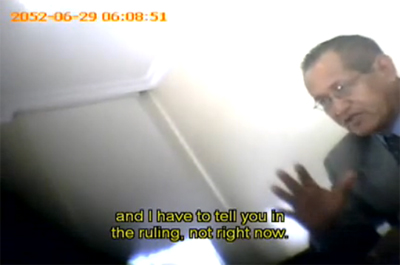
2009-09-03-nunez.jpg


As the oil giant's PR flacks and executives worked up a sweat fanning the flames of its contrived controversy, the judge defended himself to the Associated Press:
"Never, never, never have I said that it will go against" Chevron, the judge said. "They asked me if a sentence would come out. I said, 'Yes sir, a sentence will come out.' For or against? I have never said anything."

The "bribery plot" Chevron trumpets in its press release has nothing to do with the judge or the court, and instead centers around a separate meeting at which the former Chevron contractor and American businessman discuss payments to a single, excitable man who claims to be connected to Ecuador's ruling party, for access to government contracts for remediation of Chevron's contamination.

In fact, the whole episode raises more troubling questions about Chevron than about the judge or Ecuador's judicial process that the company has spent so much time impugning. 

Chevron denies it had anything to do with soliciting or supporting the apparent sting operation by the former logistics contractor for the company. But Chevron executives have had the video since June, and didn't notify any Ecuadorian or American authorities in advance of its media blitz. Chevron also admits that it paid for the relocation of the former Chevron contractor and his family to the U.S., and has provided other "interim support." Even more suspicious is the fact that Chevron has not allowed reporters covering the story to speak to its former contractor, or the American businessman for whose benefit the meetings were set up.


Steven Donziger, an American lawyer who advises the Amazonian communities in the lawsuit, says it "reeks of a Nixon-style dirty tricks operation and Chevron's fingerprints are all over it."


For years, the company has been losing the argument, so it changes the subject:

"There is no contamination. But if there is contamination, it's not dangerous. And if it is dangerous, it's not ours. And if it's ours, uh, uh... Corruption! Extortion! Defamation! Left-wing tyranny!"


This specious "bribery plot" is Chevron's latest attempt to change the subject and delay the ruling in the case.


Nothing that Chevron presents in the videos alters the underlying facts of the case. 30,000 indigenous people and campesinos living in the Ecuadorian Amazon continue to suffer a severe public health crisis, including an epidemic of cancer, miscarriages, birth defects, and other ailments. The formerly pristine rainforest and Amazon waterways have been poisoned. And it is due to the fact that the oil company operated using substandard practices that were obsolete in order to increase its profit margin by $3 per barrel.


But you don't have to take my word for it.

Go see the new documentary film CRUDE, and judge for yourself. The film looks at the unprecedented legal battle in the Amazon from all sides. Besides raving about how thrilling and gripping it is, reviewers have praised CRUDE for its "balance," "depth," "intellectual honesty," and "even-handed manner."


Unfortunately for Chevron, the truth has a way of bubbling to the surface, like crude in the steamy jungles of Ecuador.


CRUDE opens in New York on September 9th, followed by Los Angeles, San Francisco, and about thirty more cities across the country. Click here to see when it's coming to a theater near you and visit www.ChevronToxico.com to learn more about Amazon Watch's Clean Up Ecuador Campaign
.

Follow Han Shan on Twitter: www.twitter.com/coldmtn


Tuesday, February 10, 2009

Chevron Bribing Becomes SOP?

We've written before about Chevron's willingness to jump into the bribing business, where expedient, paying soldiers, auditors, etc. But now it appears this is just becoming a day-to-day thing for the company. According to the Asia Times, Chevron has refused to disclose how much the company paid officials in Cambodia to secure the rights to drill in the area.

''[Chevron has] yet to respond to our detailed questions in a letter written to the company in October 2008,'' said Gavin Hayman, campaigns director for Global Witness (GW), a London-based anti-corruption watchdog. ''It is not in favor of supplying information about what it pays foreign governments to secure rights for oil exploration.''

Chevron's attitude towards disclosure ''will be telling'', he said in an interview, since revelations could help measure the scale of ''under-the-table payments'' involved in a country where a small and powerful elite has ''captured the country's emerging oil and mineral sectors'' for personal gain.

According to the article, Cambodia lacks a well-functioning anti-corruption regime and is susceptible to "the powerful few filling their personal coffers" from the extractive industry. This is a perfect situation for Chevron and is very reminiscent of Ecuador circa 1964 or so. After all, the company has already been awarded part of the mining contract, with oil to start flowing in 2011 to the tune of $174 million annually, with oil production probably reaching $1.7 billion annually at its peak.

Hey Cambodia, be careful – I know this oil deal-with-the-devil thing seems like a good idea now, but you may want to take a look at how this same dance worked out for Burma, Ecuador and Nigeria. You may figure out that you don't want to be dealing with cancer, human rights violations, and the wholesale destruction of your country 20 years down the line.

Just a thought.

Wednesday, December 17, 2008

Corruption: Shouldn’t We All Just Say No?

As I stumbled through the internet doing some follow-up research on the Foreign Corrupt Practices Act (FCPA) (following up on my post from a couple of weeks ago), as I was surprised to find that I'm not the first one to look to Chevron while investigating the FCPA: Charles James, the general counsel and head lawyer for Chevron recently spoke at U.C. Berkeley's law school, Boalt Hall, at a conference on global corruption.

While there wasn't a full transcript on the event, it seems from the summary of remarks that James identified himself as "not a big fan of the Foreign Corrupt Practices Act" and heavily criticized the enforcement of the law, seemingly arguing that when the law is enforced, companies like Chevron are at put at a competitive disadvantage.

James' remarks offered a very different perspective than the other panelists. Judith Miller, general counsel of engineering giant Bechtel corporation, argued that the short-term pain of losing business to companies that do pay bribes is well worth the payoff of curbing corruption, since bribes hurt the countries that receive them AND the companies that pay them (since the bribes retard development of the countries, encourage further corruption, and force the companies to incur additional operating costs to secure contracts). However, James doesn't seem to see it this way, only seeing the FCPA as putting Chevron at a competitive disadvantage because they can't legally pay foreign officials for preferential treatment.

You would think a company running a massive p.r. campaign to show their good corporate governance – the "human energy" initiative – would embrace the FCPA. But under Charles James, I guess not.

Tuesday, December 2, 2008

Why The Foreign Corrupt Practices Act Needs Reform

As the Bowoto v. Chevron trial came to a conclusion in San Francisco, a disturbing trend has emerged that raises questions about Chevron's commitment to human rights. Well, at least one other disturbing trend has emerged -- much has already written about some of the disturbing threads that have emerged regarding Chevron's legal department (looking at the questionable tactics of General Counsel Charles James and the hiring of the controversial William Haynes who signed off on water boarding and other "harsh interrogation techniques" while working for Donald Rumsfeld) and some of the "interesting" defenses that the company has asked the jury in the case to buy.

But in light of all of this, it wasn't too surprising to learn in the Bowoto trial that Chevron regularly paid the Nigerian military forces for private protection -- including a bonus for the "special duty" that they performed in May 1998 when they shot and killed two protesters and wounded several others who had occupied a Chevron oil platform. Remember, evidence from the Bowoto trial proves that Chevron knew that these military forces had a track record of committing vicious human rights abuses. Even the US State Department had documented their abuses in the department's annual Country Reports. Yet, Chevron paid them anyway. Why? It seems that their very brutality is what made them attractive to Chevron. After all, such a reputation can be a powerful disincentive to local residents who want to protest.

Paying the soldiers of foreign countries to moonlight as a private security force is an inherently corrupting practice that undermines the rule of law and the neutrality of a foreign army. Imagine the uproaor if PDVSA, Venezuela's national oil company, decided to pay U.S. soldiers from Fort Bragg a bunch of cash to guard local Citgo gas stations with high-powered weaponry while they were on active duty. That's exactly the model that Chevron was using in Nigeria, with the primary difference being that at least a Citgo gas station would probably not be poisoning local water sources.

Payments of relatively small amounts of money can cause local soldiers, most of whom earn meager salaries, to be more loyal to company (Chevron) than to country. The risk is these soldiers can easily turn their guns on the very citizens they are supposed to be protecting in the name of providing "security" to an American company. That's the essence of what happened on Chevron's oil platform that day in Nigeria. Soldiers lost all sense of mission because they had been corrupted by an American company that essentially bribed them to turn their weapons against their fellow citizens.

You'd be surprised at how common the practice is even if the results are usually less tragic than what happened in Nigeria. In a fascinating expose, Jane Perlez of the New York Times demonstrated how the Louisiana-based Newmont Mining Company was paying soldiers in Indonesia huge salaries to protect operations in that country that were causing massive environmental damage. Similarly, the Burmese army guarding Chevron's pipeline in Burma has been accused of rape, murder, and forced conscription. In Ecuador, where Chevron is on trial for environmental damage, the company was scandalized in the national press for paying soldiers -- apparently in violation of Ecuadorian law -- for protection and housing for its lawyers at a local military base. In each of these cases military forces receiving "supplements" from Chevron became Chevron's local armed thugs who presumably were acting in Chevron's interests and under Chevron's orders.

This entire structure allows corporations to evade accountability. Because the armed forces are not directly employed by Chevron, Charles James can throw up his hands and claim Chevron had no control. Yet the victims generally cannot sue their own armed forces without risking further retaliation.

Given these dangers, Congress should extend the Foreign Corrupt Practices Act to outlaw direct payments by American companies to foreign military forces. Companies should pay taxes in their host country, the proceeds of which can help professionalize these forces. If security is such a problem, companies like Chevron can hire private security guards with clear lines of accountability to the company.