Showing posts with label RICO. Show all posts

Friday, June 13, 2014

Chevron: Release The Secret Evidence That Proves Your Guilt In Ecuador

Reposted from Karen Hinton on the The Huffington Post

In the wake of a controversial U.S. court ruling that a $9.5 billion Ecuador judgment against Chevron is fraudulent, the oil giant has been touting loudly its innocence of any environmental crimes in the South American country.

Chevron's lawyers even successfully pressured some CBS News corporate suits to yank a damning 60 Minutes piece from the network's website about the deliberate contamination of the Ecuador rainforest from 1964 to 1992 by Texaco, which Chevron later bought.

(See the dead link here. You can see the segment on my company's web site. So sue me, CBS.)

Instead of succumbing to Chevron's pressure tactics, CBS' lawyers should grow a backbone and demand to see contamination "playbook" documents that Chevron has been forced to produce in an international arbitration proceeding.

They are explosive and prove 60 Minutes got it right, and the U.S. judge got it wrong.

The playbook details how the company hid evidence of contamination during an eight-year Ecuador trial resulting in a $9.5 billion damage award that the Ecuadorians are waiting for Chevron to pay.
Meanwhile, Chevron is claiming in arbitration that the Republic of Ecuador should pay the judgment, and the two parties are duking it out before a panel of corporate trade lawyers who rent office space at The Hague and act as "judges" – more about them later.

The playbook took center stage in a recent arbitration filing by Ecuador. It appears the country's lawyers have gotten their hands on much, if not the entire, playbook, but the corporate trade lawyers are requiring Ecuador to redact or cover up the really damning evidence.

Even so, a recent rejoinder filed by Ecuador reveals enough to demonstrate what a morally bankrupt company Chevron is. (See the redacted rejoinder here.)

Here's what we know about the playbook, pieced together from the filings of both the Ecuadorians in U.S. court and the Republic of Ecuador in arbitration.

In 2011, the Ecuadorians obtained a few pages from the playbook and tried to enter them into evidence during Chevron's "fraud" trial, but Federal Judge Lewis Kaplan refused to allow any evidence of contamination into the record, including the small excerpt from Chevron's playbook.

(See my recent blog about this legal travesty, and this earlier 2011 press release about the playbook.)

During the Ecuador trial Chevron's paid experts wrote the playbook to document how to handle the contamination they found at the well sites in soil and water tests.

Without the knowledge of the Ecuador court, Chevron's experts conducted unofficial and secret pre-inspections of the sites so they could avoid the badly contaminated areas during the official judicial inspections. (See page 63 in the rejoinder.)

Their pre-inspection findings would have been devastating to their case had they been turned over to the court. So they never were. (See page 63.)

Instead, they used the results to avoid the contaminated areas and test at clean spots, usually from soil and water at elevations higher than the huge, unlined and open pits Texaco built to store permanently pure crude and toxic water.

[Quick backgrounder: Texaco explored for oil in Ecuador from 1964 to 1992 and was the sole operator of the well sites during that time. The Ecuadorians filed their original lawsuit in the U.S. against Texaco in 1993, one year after Texaco left Ecuador. A U.S. judge dismissed their lawsuit ruling in 2001 at Texaco's urging the litigation should be heard in Ecuador. That year, Chevron bought Texaco. In 2003, the Ecuadorians re-filed their case in Ecuador but not before the U.S. 2nd Circuit Court of Appeals instructed Chevron that it must accept Ecuador's jurisdiction, which it did.]

Chevron routinely used deceptive methods, such as mixing clean soil with dirty and undercounting hydrocarbons, to hide or reduce toxic chemicals in samplings. (See pages 66-72.)

This table below, taken from the arbitration filing, reflects just a few of the thousands of pages of playbook notes Chevron's experts and field personnel took, describing the contamination and advising the company about ways to avoid it during the official judicial inspection.


It's heavily redacted. If it's true – as Chevron says it is – that the oil giant is innocent, and the truth is what it seeks, then why won't Chevron release the un-redacted, unedited playbook for all to see?
Maybe it has something to do with the 1995 remediation agreement that Chevron argues is its get-out-of-jail-free card.

The agreement, between Texaco and the Republic of Ecuador, released Texaco from government liability in exchange for a cleanup of a relatively small number of pits. It did not, however, release Texaco from third-party claims.

During the Ecuador trial, tests found contamination levels at the so-called remediated Texaco pits as high or higher than the ones not cleaned. The Ecuadorians accused Texaco of simply throwing dirt on top of the contamination to hide it.

Chevron's playbook backs that up.

At pits Texaco said it cleaned, Chevron – according to its own playbook – found contamination during its secret PIs or pre-inspections. To avoid or reduce the contamination Chevron, during the official judicial inspection, took soil only from the top layer.

Ecuador's rejoinder references the playbook notes of Shushufindi 24, Sacha 21 and Lago Agrio 6, all three well sites that Texaco said it cleaned.

In its secret, pre-inspections Chevron discovered otherwise. (See pages 68-69.)

The rejoinder reads: "During the JIs (judicial inspections) Chevron's experts sought to avoid finding pollution by sampling only to depths that it knew to be clean. For example, at Shushufindi 24, the soil boring log at pit 2 shows that during its PI, (pre-inspection) REDACTED "Then at the JI, Chevron strategically chose to take surface soil samples only – avoiding the known contamination below."

Chevron: What did you find at Shushufini 24, Sacha 21 and Lago Agrio 6?

If you found little or no contamination, then all is well.

If you found contamination and withheld it from the court, then your remediation agreement comes unraveled as does your entire legal case.

Chevron will say today that pre-inspections were allowed, but that's not what its attorneys said during the trial. Chevron wrongfully accused the Ecuadorians of pre-inspections, telling the court that pre-inspections were a "violation of legal security and due process of law," and "no technical team from ChevronTexaco Corporation has performed any secret tests here."

The rejoinder reads:"Yet by that time, Chevron's experts had conducted PIs at least REDACTED (number of) sites and taken over REDACTED (number of) samples." (See page 65.)

Chevron wants its shareholders to believe the Ecuadorians are history, even though enforcement lawsuits are underway in three countries and an appeal of the U.S. ruling is pending before the Second Circuit Court of Appeals, which reversed an earlier Kaplan attempt to stop enforcement of the Ecuador judgment.

And, while the Republic of Ecuador is fighting aggressively Chevron's arbitration claim, it is doubtful the arbitration panel will rule against the oil giant.

Brought in 2009, Chevron's arbitration action is based on alleged violations of Ecuador's Bilateral Trade Agreement with the United States.

For some time now, multi-national corporations have been abusing these trade agreements. Allowing it to happen are the corporate trade lawyers who sit on arbitration panels as judges and then rotate off as lawyers representing corporations before panels composed of their trade lawyer buddies.
Best example is the successful claim by Phillip Morris against Australia because the country placed warning signs on cigarette packs about the dangers of smoking after Phillip Morris began selling cigarettes there. See here.

International arbitration is fraught with serious conflicts of interest, and some countries are considering ending bi-lateral trade agreements due to numerous upside down arbitration rulings that have put the interest of corporations above a country's residents.

The Ecuadorians' best bet is in Canada, Brazil and Argentina where they have filed enforcement lawsuits to seize Chevron's assets in those countries as payment for the judgment.

Who knows? The entire Chevron playbook may see the light of day in one of those courtrooms soon. Or, 60 Minutes could stand by its work and demand to see it.


Ironically, during Chevron's "fraud" trial, Kaplan quoted former Supreme Court Justice Louis D. Brandeis' famous maxim that "sunlight is said to be the best of disinfectants" but when it comes to the allegations leveled by the Ecuadorians and their lawyer, Steven Donziger, Kaplan and the corporate trade lawyers hanging out at the Hague prefer the dark side of the moon.
Wednesday, October 30, 2013

Donziger & Ecuadorians File Motion to Strike Testimony of Chevron's Well-Paid Witness


Today, the legal team for Steven Donziger and the Ecuadorians targeted by Chevron's retaliatory RICO suit filed a motion—filled with devastating detail—to strike the testimony of the oil giant's star witness.

That star witness, disgraced former Ecuadorian Judge Alberto Guerra, testified during the RICO trial last week that representatives of the Lago Agrio Plaintiffs secured the opportunity to ghostwrite the 2011 judgment against Chevron issued by the Ecuadorian court by promising the presiding judge $500,000.

Well, I guess Chevron can rest its case. Silver bullet. Or, more like magic bullet.

One of the main problems with the story—besides the fact that it never happened—is that after weaving his tall tale, Guerra admitted that he had offered between ten and twenty bribes to judges during his career as a lawyer and after becoming a judge, accepted about the same number of bribes, sometimes for as small as $200, to "fix" cases.

But it gets worse, at least for the credibility of his fanciful testimony. From today's motion:

Guerra further understood from multiple conversations and lunch meetings with Chevron attorneys—where, as Guerra’s testimony revealed, they always fully heard out his offers and consulted with their principals before allegedly saying “no”—that as an out-of-work former judge with no role in the case, he simply didn’t have the “goods” Chevron wanted. Guerra had every incentive to manufacture those goods so that he could bargain hard with Chevron about the price of his testimony. And bargain he did, lying repeatedly to Chevron—i.e., that he was in possession of emails that would confirm Chevron’s ghostwriting allegations; that he possessed drafts of the Judgment; that the Lago Agrio Plaintiffs had recently offered him $300,000 to cooperate—in order to improve his bargaining position.

Okay, so the guy is an admitted liar and criminal but you know, maybe he's telling the truth now. What incentive could he possibly have to make up a new story now? Back to the motion:

When, after a long career of paying and accepting bribes, Guerra apparently decided that he would place himself in the service of Chevron, the former judge was earning $500 per month and had no savings. In contrast, Chevron has committed to paying Guerra, for a period of at least two years, a “salary” of $10,000 per month—20 times more than he was earning in Ecuador. It is unclear what need Guerra has for such a generous salary, in light of the fact that Chevron also: (i) provides Guerra with a monthly $2,000 “housing allowance”; (ii) bought Guerra a car and is paying for his auto insurance; (iii) is paying for health insurance to cover Guerra, his wife, his son, his son’s wife, and his grandchildren; (iv) paid Guerra roughly $12,000 to purchase household items upon his move to the U.S.; (v) paid Guerra’s moving expenses, including five airline tickets, transportation of personal items, and a temporary hotel stay upon arriving in the U.S.; (vi) paid Guerra roughly $50,000 in exchange for “evidence,” including $10,000 for belatedly finding a single document that supposedly eluded Guerra upon prior searches because it was “stuck” to something else; and (vii) pays the legal fees of Guerra’s various attorneys, including the fees of the lawyers handling immigration issues for his various family members. Guerra’s relocation on Chevron’s dime also reunited him with his daughter and a second son, who live in the U.S. and who Guerra had not seen in several years.

In other words, Chevron is bribing a judge to say that Donziger bribed a judge.

And the package Chevron has put together for this judge is outrageous, and egregiously runs afoul of federal law and ethical rules of conduct.

The motion outlines how the payments violate the federal Anti-Gratuity Statute as well as the Rules of Professional Conduct of New York, where the trial is taking place. By all means, read the motion for a detailed explanation of the rules but here is the view of prominent legal scholar and law professor Erwin Chemerinsky in a sworn declaration for the Defendants:

“if a party or its counsel were permitted to pay a testifying witness for physical evidence, beyond the reasonable value of that evidence, and to pay the witness a salary in exchange for an agreement to testify, there would be little left of the rule against compensating fact witnesses.” 

And the conclusion of the motion on the payments to Guerra?:

The bottom line is that Guerra is and apparently always has been desperate for money, and will stoop to extraordinary lows to get it—including fabricating a story for Chevron, weaving big lies with small truths in an effort to create the illusion of a verified account. Guerra’s recent testimony only serves to drive his unreliability home.

The motion is well worth reading in its entirety as it also highlights the admitted lies, the contradictions, and the suspect assertions in Guerra's testimony, as well as the total lack of anything approaching corroborating evidence for his explosive allegations.

During cross-examination, Guerra explained that he spent 3-4 days of every week for 3 full months in New York working with a team of Gibson Dunn lawyers led by Randy Mastro in preparation for his two days in court. That should be enough time for even a novice actor to learn his lines, no matter how fanciful a story he’s telling.

And hey, if it means reuniting with his beloved family in the United States, where he’ll enjoy a lifestyle he could only dream of before, it’s time well spent. And then some.

And for Chevron?

Simple. Guerra’s testimony is Chevron’s ‘magic bullet’ to save its RICO case and help the company avoid paying the $19 billion judgment for its devastation of the Ecuadorian Amazon.

If it worked, it would be money well spent.  And with a biased federal judge presiding, it probably will work – until a real court, the Second Circuit Court of Appeals, reviews the matter down the road. 

Never mind that the money spent on bribing Guerra to fabricate his story could be used to clean up the company’s contamination in Ecuador. But for Chevron, living up to its legal and moral responsibilities overseas would set a terrible precedent. 

In the end, Guerra’s preposterous testimony, bought and paid for by Chevron, his court performance the culmination of months of preparation by a team of highly-paid lawyer-thespians at Gibson Dunn, adds one more layer of absurdity to the farce that the current proceedings represent. A single federal judge in New York can no more act as an appellate court for the entire Ecuadorian Judiciary than Alberto Guerra’s words can be taken as the truth. And Chevron can no more hide from the truth than the company’s legal machinations can conceal its contamination, and its liabilities, in Ecuador.

Tuesday, October 15, 2013

Eye on the Amazon: Retaliation Trial Opens Against Victims of Chevron Contamination in Ecuador

Reposted from Eye on the Amazon

Javier Piaguaje

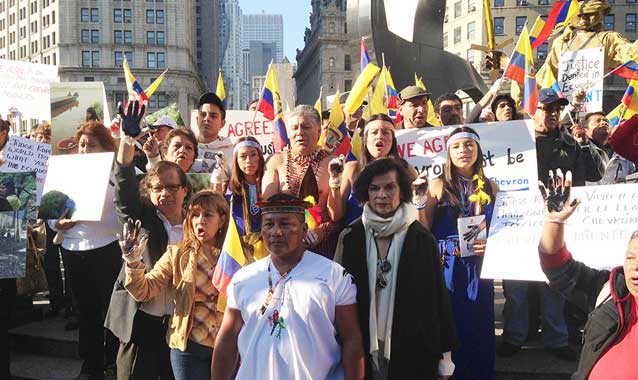
Today in New York Ecuadorian villagers from the Amazon rainforest region ravaged by Chevron's oil contamination were joined by supporters for a rally in Foley Square across from the courthouse where a trial opened in the California-based oil giant's retaliatory RICO lawsuit against the Ecuadorians and their U.S.-based legal advocates.

The Ecuadorians are representing 30,000 plaintiffs who won a landmark judgment against Chevron in an Ecuadorian court in 2011 in which the company was ordered to pay more than $18 billion for cleanup of widespread contamination, as well as compensatory and punitive damages. The case holding Chevron accountable for toxic dumping by its predecessor company, Texaco, has been upheld by appellate courts in Ecuador.

After nearly 20 years since the case was filed in 1993, Chevron still refuses to pay for a cleanup and is waging a scorched earth legal, PR, and lobbying campaign to crush its victims and their advocates and supporters. The oil giant stripped its assets from the country, forcing the Ecuadorians to pursue enforcement of the judgment in countries where the company maintains assets.

While Secoya indigenous community leader Javier Piaguaje continues to contest that the New York court can assert Personal Jurisdiction over him, he has traveled to New York to represent the tens of thousands of Ecuadorian plaintiffs who couldn't be there and defend them against Chevron's insulting allegations. He had this to say outside the courthouse in Foley Square today:
Ladies and gentlemen,


30,000 people were affected by Chevron's contamination and each day this number increases. Almost 30 years of criminal operation by the Chevron-Texaco oil company in Ecuador; more than 1,500 square miles of contaminated Amazonian rainforest; rising cases of cancer that almost always end in death; the suffering of our women for the great number of miscarriages; the devastation of the ecosystems and the destruction of thousands of species of plants and animals.


When Texaco arrived, we were expelled from our ancestral lands and two indigenous peoples went extinct. What the oil company brought to the Ecuadorian Amazonian was violence, death and destruction; meanwhile, the company got all the riches that the land offers at the cost of our lives, our health, and our home.


For this reason we continue our efforts to hold Chevron accountable, so that the company pays for all of the harm that it caused. We are here in New York now, where Chevron persecutes us and accuses us of being criminals and is supported by a judge who doesn't know our reality and suffering and hopes. Who are the real villains in this story?


We are outside this courthouse to tell the history that Judge Lewis Kaplan has refused to hear. Our misery is real and it will not cease to exist by a judicial process in New York, where Chevron hopes to avoid its responsibility with the collaboration of a judge that isn't even willing to validate the harm that we've had to endure. We come to denounce the abuse that is being committed in affected communities but also to tell them that we have already fought for 20 years and this RICO lawsuit will not stop us in our quest for justice.


The oil company has declared that it will fight us "until hell freezes over." Obviously our economic conditions are not the same; they can buy justice, we cannot. Because of this we must unite to fight against a giant that understands money, but not values like solidarity, truth, fellowship, and above all, justice.


Our fight is to keep the Amazon, the lungs of the planet, alive.


Our fight should interest the whole world.


We unite to make the world a place that is worth living in. The Amazon was one of those places. With your help, it can be again.


Thank you.
Forty-seven "named plaintiffs" – all of them indigenous rainforest residents and rural villagers – have been named in Chevron's lawsuit, which alleges that the entire case is a conspiracy to extort the company. Two of the Ecuadorian villagers, while rejecting the New York court's jurisdiction over them, have nonetheless appeared in the case in order to fight the allegations. Fearing a public backlash for suing victims of its pollution, Chevron has focused its smear campaign on New York-based human rights attorney Steven Donziger, who has advised the Ecuadorians in their efforts since first visiting the contaminated region in 1993.

The Ecuadorians and their supporters have called for an end to Chevron's retaliatory lawsuit, and are calling this latest effort a "rigged show trial" before a federal judge, Lewis A. Kaplan, who has displayed outright hostility to the Ecuadorians' legal efforts to demand a cleanup. Judge Kaplan has also made repeated disparaging on-the-record comments about Ecuador's judicial system.

Texaco operated in Ecuador until 1992, and Chevron absorbed the company in 2001, assuming all of its predecessor's assets and liabilities. Chevron has admitted to dumping nearly 16 billion gallons of toxic wastewater – the byproduct of oil drilling and pumping – into rivers and streams relied upon by thousands of people for drinking, bathing, and fishing. The company also abandoned hundreds of unlined, open waste pits filled with crude, sludge, and oil drilling chemicals throughout the inhabited rainforest region. In other countries at the same time as it was operating with no environmental controls in Ecuador, the company re-injected wastewater and used other easily-deployed technologies to deal with the toxic byproducts of its activities.

Multiple independent health studies have shown an epidemic of oil-related birth defects, cancers, and other illness. It is estimated that the contamination has directly led to at least 1,400 deaths.

More Information:

For more on the campaign to hold Chevron accountable for its abuses in Ecuador: ChevronToxico.com

For more on the impending trial in Chevron's retaliatory lawsuit: StevenDonziger.com

Tuesday, October 8, 2013

Judge Kaplan Denies Jury Trial for Donziger and Ecuadoreans

Today, the New York Law Journal ran an article on its front page about the upcoming trial in Chevron's retaliatory RICO lawsuit against the victims of Chevron's abuses in the Ecuadorean Amazon, and their long-time U.S. attorney, Steven Donziger. The piece begins:
The pitched battle between Chevron Corporation and a lawyer and Ecuadorians who won a multi-billion-dollar environmental judgment against the oil company in Ecuador is set for trial on Oct. 15, before Southern District Judge Lewis Kaplan.
Reporter Mark Hamblett opens with the competing narratives—Chevron on one side, human rights attorney Donziger and the Ecuadoreans on the other—in this case:
Kaplan Monday denied the request of attorney Steven Donziger and two of his Ecuadorian clients for a jury trial in the case, where Chevron is alleging Donziger ran a racketeering conspiracy to win the so-called Lago Agrio litigation in Ecuador by fraud, and Donziger is accusing Chevron of scorched-earth tactics to avoid taking financial responsibility for environmental damage left behind by a predecessor oil company.
As the trial evidence mounted in Ecuador over Chevron's devastation of a sprawling swath of inhabited Amazon rainforest, it became increasingly clear that Chevron would likely be found liable. On that, the company was right, and in February 2011, the oil giant was ordered to pay nearly $19 billion in compensatory and punitive damages.

But by then Chevron had launched its retaliatory campaign against Donziger and the Ecuadoreans. In 2009, with an adverse judgment from the Ecuadorian court looming, Chevron press operative Chris Gidez wrote in an internal company memo that “our L-T [long-term] strategy is to demonize Donziger.”

Today's NY Law Journal article continues:
After Chevron filed its lawsuit, Donziger said, "It then used 'the explosive' 'thermonuclear' impact of the allegations—the 'terrorizing' effect of civil RICO 'as another court has described it'—to launch a global smear campaign designed to destroy my reputation, chill my free speech rights, and drive me away from representing the Ecuadorian communities who are my clients. This campaign was promoted, encouraged and amplified by the very court that Chevron now seeks to preside over a bench trial."

In addition to "fundamental fairness" requiring a jury trial, Donziger said, "Chevron has accused me of being a 'criminal' in open court," and "it would amount to a travesty of justice to deny me and my clients a jury trial in what is essentially a private prosecution funded by corporate largesse."
Legal Newsline covered the development today as well, quoting Donziger spokesman Chris Gowen, who called Kaplan's decision “a clear abuse of power” and said that it shows Chevron doesn’t believe in its own case:
“This critical decision made only days before trial virtually guarantees Chevron its desired outcome from a judge who already has decided all key issues in the case before evidence has been presented,” Gowen said in a statement.
While Judge Kaplan—who famed trial attorney John Keker charges with allowing Chevron’s RICO case to degenerate into a “Dickensian farce”—remains intent on being the sole decider, Donziger and the Ecuadoreans are preparing for trial.

As we file this post, there is one brief comment on the Legal News Line article from a reader named Peter. We don't know who Peter is but we think he nails it:
The fact that Donziger is prepared to risk a huge financial judgement in order to be tried by jury clearly illustrates which side is more confident of its merits.


Thursday, October 3, 2013

Chevron Continues Abusive Efforts to Rig Trial in Retaliatatory RICO Case vs. Donziger and Ecuadorian Villagers

Last week, after bringing in heavy-hitting trial lawyer Ted Olson to argue its case, Chevron prevailed in its effort to keep its favorite judge overseeing the upcoming trial over the oil giant's retaliatory lawsuit against lawyer Steven Donziger and his clients from the Ecuadorian Amazon. Days later, on the eve of the trial, Chevron dropped its damages claims against Donziger.

Why would they do that?

Well, once Chevron secured Judge Lewis Kaplan—who has displayed outright bias against the Ecuadorians and their legal team who sued Chevron over its rainforest Chernobyl—the company wanted to make sure it was Kaplan, and Kaplan alone, deciding the case.

As The Wall Street Journal—a pro-Big Business organ if there ever was one—put it:

"Trying the case before a jury would be riskier for the company, experts said, in part because jurors might not be sympathetic to its argument that it has been victimized by the lawyers for Ecuadorian villagers."
In other words, a jury would likely see right through Chevron's cynical efforts to play the victim after being found guilty of massive oil contamination—causing a horrific epidemic of oil-related sickness and death amongst thousands of poor rural Ecuadorians—in one of the most-litigated environmental cases in history.

And so, the company argued, without damages claims, Donziger loses his right to a jury trial.

But, according to a press release today, Donziger and the other RICO defendants disagree, and will pressing their view before the court tomorrow:

Donziger and his clients are due to file a motion tomorrow explaining why the law still requires a jury rather than allowing a bench trial before Judge Lewis A. Kaplan, who has a documented history of bias in favor of Chevron.

But, in addition to making sure the oil giant's dear friend in the federal court is the sole "decider," the company is going to alarming lengths to rig the trial:

Chevron is now trying to bar any and all evidence of environmental contamination in Ecuador from its RICO case as part of a strategy to deny rainforest villagers and their New York attorney Steven Donziger a fair trial, according to recent court filings.
The press release continues:

Chevron has asked Judge Kaplan to bar Donziger and the Ecuadorians from using any of the overwhelming scientific evidence that proved the company’s guilt when it was found liable by the Ecuador court for $19 billion in damages.

Chevron also has asked Judge Kaplan to bar Donziger and the Ecuadorians from presenting evidence related to “environmental and human conditions” in the affected area of Ecuador’s rainforest and to exclude the use of any scientific studies related to the contamination.  The Ecuador court relied on such studies as well as tens of thousands of chemical sampling results to find Chevron liable in the case.

Christopher Gowen, a law professor and spokesman for Donziger and the Ecuadorians called Chevron’s attempts to restrict evidence “stunning in breadth and scope,” saying:

"Chevron obviously is so afraid of its own wrongdoing that it wants to have an environmental trial without talking about the environment. That’s what corporate polluters do when they get caught with their pants down.”

Chevron's shocking requests to Judge Kaplan are laid out in its Summary Notice of Motions in limine. Here is an excerpt:

    Chevron requests that this Court enter an order: 
  • precluding Defendants from offering at trial evidence, arguments, or questioning in support of the proposition that the findings of the Cabrera report, the Ecuadorian judgment, or Defendants’ allegations in the Ecuadorian proceeding were accurate or supported by evidence and sound scientific analysis, including but not limited to a prohibition on the submission of evidence, arguments, or questioning regarding the following topics, except insofar as the evidence is otherwise relevant:
  • alleged environmental and human conditions in the Oriente region of Ecuador, including scientific or other studies, testing or sampling results, video or still images, or personal testimonies; and
  • the procedures employed in the TexPet Remediation, the efficacy of those procedures, or their compliance with agreements and with Ecuadorian law.

Today's press release outlines more:

In various court filings, Chevron also has asked Judge Kaplan to bar Donziger and the Ecuadorians from presenting evidence of:

**Chevron’s repeated contacts with high-level government officials in Ecuador to try to illegally quash the case;

**Chevron’s many private contacts with Ecuadorian judges and independent court experts;

**Chevron internal videos showing company technical experts in Ecuador laughing at the pollution while discussing ways to hide it from the court;

**Personal testimony from individuals about pollution and health impacts that was relied on by the Ecuador court;

**Chevron’s sting operation against an Ecuador judge where the company tried to orchestrate a fake bribery scandal to derail the trial;

**Chevron’s creation of dummy companies to hide its control of a supposedly independent laboratory that processed soil samples for the court;

**Evidence that the legal team for the rainforest communities received death threats and were harassed during the trial;

**Evidence of Chevron’s surveillance of Donziger, Ecuadorian lawyer Pablo Fajardo, and others;

**Evidence of Chevron’s lobbying contacts in the U.S. designed to pressure Ecuador’s government to quash the case.

Pablo Fajardo, lead lawyer for the rainforest communities in Ecuador, commented:

“We thoroughly reject Chevron’s blatant attempt to rig the trial before Judge Kaplan by barring the decades of accumulated evidence of its environmental crimes, fraud, and misconduct in Ecuador."

As always, for an overview of Chevron's crimes in Ecuador, watch this video overview or this 60 Minutes segment, or review this summary of the overwhelming evidence against the company.  Chevron is now fighting a $19 billion judgment against the company.

Become a follower of  The Chevron Pit.
Follow us on Twitter at @ChevronPit and like us on Facebook.
Visit and watch a video on ChevronToxico.com to find out more.
Support Amazon Watch and Rainforest Action Network.

Tuesday, September 10, 2013

Ahead of Trial, Chevron Drops $60 Billion Damages Claim Against Ecuadorians in RICO Suit; Maneuvering to Avoid Airing of its Crimes in Ecuador


In a clear 11th-hour retreat that suggests it does not believe its own allegations, Chevron has taken the extraordinary step of pleading with a U.S. judge to block a jury from deciding its retaliatory “fraud” and RICO claims against Ecuadorian villagers and their U.S. lawyer. The company also said it was even prepared to drop a $60 billion damages claim if the judge agrees to deny the defendants a jury trial. Chevron's $60 billion figure is based on three times the $19 billion Ecuadorian judgement, plus costs.

Thus reads the introduction of a press release today—the headline: 'Bombshell Retreat: Chevron Seeks to Drop $60 Billion in Damages In Ecuador Case'—from the Gowen Group, whose founding partner Chris Gowen is serving as an adviser to the Ecuadorians and their longtime New York-based lawyer, Steven Donziger.

Chevron filed a series of motions over the weekend in the retaliatory lawsuit the oil giant filed against Donziger as well as the Ecuadorians whose names appear as representative plaintiffs in the original lawsuit against Chevron for massive contamination of their rainforest communities. Here is the motion dropping its damages claims against the Ecuadorians.

Adviser Chris Gowen said, “Chevron has shown over and over that its only legal strategy is to outspend everyone and continue to run from the law for another twenty years. When a litigant tries to avoid a jury, you can be certain that litigant knows it has no case. This is an extraordinarily telling moment that suggests a collapse of confidence in the Chevron camp.”

The press release continues:
Donziger and his clients have long contended that Chevron’s RICO case was a function of distorted and manufactured evidence helped along by Judge Kaplan, who has consistently made disparaging remarks about Ecuador’s judicial system. Donziger filed detailed counterclaims accusing Chevron of using the RICO case as a smokescreen to hide its environmental crimes, fraud and bribery attempts in Ecuador. (Kaplan has refused to let those claims go forward in the context of the RICO trial.)
And then it quotes Donziger:
“For three years, Chevron has used its RICO suit largely for public relations purposes to falsely taint the Ecuador case and tarnish my personal reputation. When it comes time to put their allegations to the test, Chevron chickens out and runs into the arms of its favorite judge for protection. The entire situation is an affront to American values.”
Advocates for the indigenous and farmer communities in the areas polluted by Chevron have for several years kept a spotlight on exactly why Judge Lewis Kaplan is what Donziger calls “its favorite judge.” He has shown shocking pro-Chevron bias; he calls the environmental lawsuit "a giant game" and the Ecuadorians the “so-called plaintiffs” and refers to them enforcing the judgment they won against the company by saying, "I don't think there is anybody in this courtroom who wants to pull his car into a gas station to fill up and finds that there isn't any gas there because these folks have attached [the company's assets] in Singapore or wherever else."

Donziger and the Ecuadorians have filed a writ of mandamus petition asking the 2nd Circuit Court of Appeals to remove Judge Kaplan for his impartiality in the case. On Sept. 26th, a 3-judge panel from the appellate court will hear arguments on the motion for Judge Kaplan's reassignment from the trial—that is, only a few weeks before the RICO trial is scheduled to begin on Oct. 15th. As the release states, “The scheduling of such an argument just before trial is a rare occurrence and suggests the higher court is watching Kaplan with great scrutiny.”

With these latest court filings, according to Donziger and his team, Chevron's goal is:
to have Kaplan conduct a rapid "show trial" that would bar Donziger and his clients from mounting a meaningful defense. Once Kaplan makes his expected “findings” against Donziger and the Ecuadorians, Chevron would then ask him to re-issue the same controversial global injunction purporting to bar worldwide enforcement of the Ecuador judgment that the Second Circuit Court of Appeals already ruled was illegal in 2011.
The most shocking stuff in Chevron's latest legal machinations is laid out plainly in their summary Notice of Motions in limine, which is an astonishing request to Judge Kaplan that he issues orders that would basically prevent Donziger and the Ecuadorians from mounting any sort of defense, or bring up any evidence of Chevron's contamination of the Ecuadorian Amazon, or its bad faith conduct during the trial in Ecuador.

Here is an excerpt:
Chevron requests that this Court enter an order:
  • precluding Defendants from offering at trial evidence, arguments, or questioning in support of the proposition that the findings of the Cabrera report, the Ecuadorian judgment, or Defendants’ allegations in the Ecuadorian proceeding were accurate or supported by evidence and sound scientific analysis, including but not limited to a prohibition on the submission of evidence, arguments, or questioning regarding the following topics, except insofar as the evidence is otherwise relevant: 
  • alleged environmental and human conditions in the Oriente region of Ecuador, including scientific or other studies, testing or sampling results, video or still images, or personal testimonies; and 
  • the procedures employed in the TexPet Remediation, the efficacy of those procedures, or their compliance with agreements and with Ecuadorian law.
In the motion, Chevron shows real hubris going even further, asking Judge Kaplan to preclude the defendants from raising at trial:
  • Chevron’s purported conduct in the Lago Agrio Litigation, including contacts with Ecuadorian government officials, arguments made by Chevron to the Lago Agrio Court, the cancellation and subsequent rescheduling of the Guanta inspection, Chevron’s purported “sting” operation against an Ecuadorian judge, Chevron’s use of a purported “sham laboratory”, Chevron’s purported “procedural misconduct” in filing motions in the Lago Agrio Litigation, Chevron’s purported ex parte contacts with Ecuadorian judges and court experts, any “harassment” supposedly suffered by Defendants or their co-conspirators, and any argument that their actions were justified by virtue of Chevron’s alleged misconduct; 
  • Chevron’s conduct in this and other litigation in the United States, including Chevron’s purported misuse of Section 1782 to obtain discovery for use in the Lago Agrio Litigation, Chevron’s subpoenas to email providers seeking information about Defendants and their co-conspirators, and Chevron’s surveillance of Defendants and their co-conspirators; and 
  • alleged promises and representations made by Texaco and/or TexPet in the Aguinda litigation.
You can read the entire motion here, and see how Chevron is hoping to abuse the judicial process in this RICO show trial, in a similar way that the company abused the judicial process in Ecuador, in an attempt to evade accountability for its disaster in the Amazon.

But the 2nd Circuit is watching. As are global supporters of the Ecuadorian communities. As are the communities themselves, who continue fighting for justice, despite the abuse they continue to deal with, from the oil-polluted environment they live in to courtrooms thousands of miles away.


For background on how Chevron decimated indigenous and farmer communities by dumping billions of gallons of toxic waste in Ecuador’s Amazon, watch this video overview or this 60 Minutes segment, or review this summary of the overwhelming evidence against the company.  Chevron is now fighting a $19 billion judgment against the company.

Become a follower of  The Chevron Pit.
Follow us on Twitter at @ChevronPit and like us on Facebook.
Visit and watch a video on ChevronToxico.com to find out more.


Thursday, August 29, 2013

Appeals Court to Consider Removing Key U.S. Judge in Chevron-Ecuador Case

A New York appellate court has said it will consider a petition to reassign federal judge Lewis A. Kaplan from an Ecuador environmental case that resulted in a $19 billion judgment against Chevron.

A press release issued today by the DC-based Gowen Group law firm outlines this potentially game-changing legal update in the case. Founding partner Chris Gowen has taken up duties as an adviser to and spokesperson for Steven Donziger, the New York human rights lawyer who has earned the ire of Chevron for his dogged two-decade effort to bring the oil giant to justice for massive pollution and human rights abuses in the Ecuadorian Amazon.

The press release continues:
The Second Circuit Court of Appeals has set Sept. 26 for oral argument on the petition to reassign the judge, who has been criticized for unfairly promoting a retaliatory Chevron “fraud” case against Ecuadorians villagers and their U.S. counsel. The reassignment petition, which is based primarily on Judge Kaplan’s refusal to follow prior appellate court orders in the case, can be read here and here.
Judge Lewis A. Kaplan is presiding over a lawsuit brought by Chevron against Donziger, Ecuadorian community leaders and Goldman prize winners Pablo Fajardo and Luis Yanza, as well as dozens of the "named plaintiffs" in the original suit against the oil company. Most of the named plaintiffs are from indigenous communities living in an area of the Ecuadorian Amazon devastated by Chevron's oil pollution. These communities have seen their livelihoods destroyed by pollution, their culture decimated by rainforest destruction, and lost loved ones to cancer and other diseases related to the toxins Chevron has admitted dumping into their environment. But that hasn't stopped Chevron from retaliating, and Judge Kaplan has wondered aloud whether these people even exist.

From the press release:
Judge Kaplan has been accused of bias for calling the Ecuador case a "giant game" invented by lawyers to “fix the balance of payments deficit” of the United States. He also referred to thousands of indigenous Ecuadorians as the "so-called" plaintiffs before imposing an illegal injunction purporting to block the Ecuador judgment from being enforced anywhere in the world. For background, see here and here.

Judge Kaplan’s injunction was reversed unanimously in 2011 by a three-judge appellate panel, dealing a stunning rebuke to Chevron’s primary defense in the case. The current petition for reassignment explains how Kaplan has continued to defy that appellate order by issuing a series of decisions disparaging Ecuador’s judicial system.
Donziger and the other defendants in the Chevron's retaliatory RICO case filed what is called a petition for a writ of mandamus, asking the Appeals Court to remove Kaplan form the case due to the bias he has repeatedly shown towards Chevron.

Amazon Watch's Eye on the Amazon blog writes that Kaplan insinuates that an "important company like Chevron should be guarded from judgment collection efforts that apparently might be acceptable if the company were deemed less vital" and quotes Judge Kaplan from an early court proceeding:
"[W]e are dealing here with a company of considerable otherwise importance to our economy that employs thousands all over the world, that supplies a group of commodities, gasoline, heating oil, other fuels and lubricants on which every one of us depends every single day. I don't think there is anybody in this courtroom who wants to pull his car into a gas station to fill up and finds that there isn't any gas there because these folks have attached it in Singapore or wherever else."
Back to today's press release for comment from Chris Gowen, an adjunct professor at the Washington College of Law who is advising the Ecuadorians and Donziger: “Chevron is desperately suing everybody it can to evade a valid judgment won by the rainforest communities the company has contaminated with toxic waste,” he said. “Chevron’s approach is clearly one of the greatest abuses of the legal system ever.”

Judge Kaplan has made numerous rulings and comments that will likely come under additional scrutiny when oral arguments on the mandamus petition take place in front of the Second Circuit Court of Appeals on Sept. 26th.

Already, Chevron has displayed some jitters as the the company's retaliatory lawsuit approaches a trial date. As reported here last week:
In an otherwise routine scheduling conference recently before Judge Lewis A. Kaplan, Gibson Dunn lawyer Randy Mastro suggested the oil giant was prepared to drop all damages claims against the Ecuadorians and their counsel, Steven Donziger, just to avoid a jury trial.
Chevron was hoping that it could get a fraud finding from Judge Kaplan without having a new round of evidence of the company's abuses put under a spotlight before a jury and the public. But with Judge Kaplan under scrutiny himself, he doesn't look inclined to go that route.

It would seem that Judge Kaplan has been one of Chevron's best assets in the company's cynical efforts to evade responsibilty for its disaster in Ecuador.  Should the Appeals Court re-assign him, it would be a huge blow to those efforts.

Stay tuned.

And as always: for background on how Chevron decimated indigenous and farmer communities by dumping billions of gallons of toxic waste in Ecuador’s Amazon, watch this video overview or this 60 Minutes segment, or review this summary of the overwhelming evidence against the company.  Chevron is now fighting a $19 billion judgment against the company.

Become a follower of  The Chevron Pit.
Follow us on Twitter at @ChevronPit and like us on Facebook.

Visit and watch a video on ChevronToxico.com to find out more.

Tuesday, August 20, 2013

Chevron Getting the Jitters Over Its RICO Case

Shaky Evidence and Appellate Court Scrutiny Starting to Disrupt Company’s Master Plan

Chevron’s vaunted 114-lawyer “rescue team” at Gibson Dunn seems to be getting the jitters over its upcoming RICO trial in federal court in New York.   
In an otherwise routine scheduling conference recently before Judge Lewis A. Kaplan, Gibson Dunn lawyer Randy Mastro suggested the oil giant was prepared to drop all damages claims against the Ecuadorians and their counsel, Steven Donziger, just to avoid a jury trial.   The company’s “Plan B” appears to be to seek a fraud finding from Judge Kaplan alone -- something the judge does not seem inclined to do, and something that would have little chance of working even if he did.
The fact Chevron is even thinking of this possibility is a huge retreat.  It’s also a strong indication that Chevron believes its billion-dollar investment in the RICO case has suddenly become a high-stakes gamble with far greater risk than CEO John Watson is letting on to shareholders and the financial markets.   A loss in the case via a jury verdict would be disastrous for the company both in the U.S. and in defending enforcement actions targeting its assets in countries around the world. 
If it were to drop the damages claims, Chevron might avoid a civil jury trial which in most cases is only guaranteed to a defendant when money is at stake.  But if Chevron chooses to go down this path, it will be left with virtually nothing to litigate.  It might get a “finding” from the discredited Judge Kaplan, but that will be of little or no use in foreign courts who already see the judge as a vassal of U.S. judicial arrogance.
To be clear: Chevron never thought the RICO case would get this far.  Juries are inherently unpredictable.  For a large corporation like Chevron with a $19 billion liability and the reputations of its senior management team at stake, that’s also terrifying.  Chevron simply cannot afford to lose this case.
Chevron assumed that the small legal team for the Ecuadorians would be ground to a pulp by now.  Or that Judge Kaplan would have found a way to rule in Chevron’s favor on pre-trial motions.  Both strategies have failed.
After being unanimously reversed in 2012 when he tried to block the Ecuador judgment from being enforced anywhere in the world, Judge Kaplan appears anxious to push Chevron’s allegations into the hands of a jury.  (That will come after the judge continues to make evidentiary decisions to rig the trial in Chevron’s favor.  See here and here for a taste of Kaplan’s bias.)  In the end of the day, Judge Kaplan knows any finding he makes alone has little chance of surviving appeal and his own instincts at this point are to protect himself, even if it means Chevron cannot get everything it wants.
Chevron also knows juries tend to follow their gut.  That does not bode well for Chevron’s absurd notion that it is the victim of a global  “racketeering scheme” foisted on it by the very indigenous groups who have had their ancestral lands poisoned by the company’s toxic dumping. This “blame the victim” approach is classic historical revisionism practiced the world over by oppressors and Chevron is no different.  
(For an understanding of the overwhelming evidence against Chevron in Ecuador, see this video, this 60 Minutes segment, and this summary of the evidence relied on by the Ecuador court to find the company liable for both polluting the delicate rainforest ecosystem and for trying to corrupt the trial that held it accountable.)
In 2011, the Second Circuit Court of Appeals reversed Judge Kaplan’s illegal injunction purporting to block worldwide enforcement of the Ecuador judgment. Judge Kaplan’s ham-fisted attempt to rescue Chevron from its misdeeds in Ecuador remains a sad example of ugly Americanism at its worst.  See here, and here to get a feel for the international scorn provoked by this short-lived attempt by a U.S. trial judge to control the Ecuador judgment on a global basis.  
Despite this personal setback – no Judge likes to get reversed -- Kaplan does not appear to be the least bit chastened from the experience.  And that’s bad for Chevron because Judge Kaplan’s hubris has put him in serious trouble yet again.
Just last week, the appellate court set oral argument in late September to determine whether Judge Kaplan should be removed from the RICO case altogether given his continued defiance of the Second Circuit’s order that he not opine on the validity of the Ecuador judgment.   See here for the latest facts underlying the petition for his removal.  Let’s just say it is serious business whenever a trial court thumbs its nose at an appellate court.  To do it on multiple occasions and blatantly is even more perilous. 
Judge Kaplan encouraged Chevron to bring the RICO action in the first place.  Without his efforts, it likely never would have gotten past first base.  The judge has jerry-rigged the evidence by repeatedly violating the due process rights of the Ecuadorians and Donziger.  He even has ruled they will not be allowed to present testimony about Chevron’s massive pollution in Ecuador, thus making it virtually impossible to mount a meaningful defense.  Should the case be reassigned to a fair judge, look for Chevron’s claims to lose all traction. 
As for the lawyers, Mr. Donziger and others are still confident.  It was Donziger who recently forced Chevron CEO Watson to testify about Ecuador during a deposition – a shocking risk given that he now could be charged with perjury if it is found that he lied under oath. This industry royal was forced to endure the humiliation of answering live questions posed by a solo practitioner (Donziger) he previously called a “criminal” on earnings calls with investors.  (Chevron has gone to great lengths to keep Watson’s testimony confidential.  When the lies and memory lapses get exposed, Watson will be further embarrassed and the global shareholder campaign against him will pick up even more steam.)
Given these problems, it is understandable why Mastro is nervous about a jury trial.  But there are other reasons.
First, Mastro is known far more as a political fixer than a trial lawyer.  He will fight like a pit bull to avoid ceding the high-profile trial stage to the many more talented lawyers at Gibson Dunn, including his colleagues Theodore Boutrous and former star federal prosecutor Reed Brodsky. Any defendant would want Mastro to lead the Chevron show before a jury.  Let’s hope he hangs in there.
We have seen from previous hearings before Judge Kaplan how Mastro and his sidekick, Andrea Neumann, lack basic courtroom agility and have an off-putting personal style.    Mastro already lost three key appellate arguments in the case and literally was laughed out of court in 2011 when he couldn’t answer the most basic questions when trying to defend Judge Kaplan’s illegal injunction before a three-judge appellate panel.  
Second, Chevron’s witness list reads like a Who’s Who of small-time thugs, criminals, and cartoon characters.  Almost all have agreed to testify because of some combination of bribes or intimidation coming from Chevron headquarters.  While the oil goliath has packaged this testimony for maximum effect in affidavits clearly ghostwritten by its own lawyers (leading to a lot of slanted reporting in its favor), under the klieg lights of trial it is doubtful that any of these people will retain even the slightest veneer of credibility.
Exhibit A is former Ecuador Judge Alberto Guerra Bastides, an admitted con artist who received a suitcase full of cash from Chevron lawyer Andres Rivero in Quito in exchange for favorable testimony.   In a deal negotiated directly by Mastro, Chevron has committed to paying Guerra at least $326,000 or roughly ten times his annual salary.  These payments are a clear violation of the ethical rules.  Given his many credibility problems, it is unclear if Guerra will even take the stand.  If he does, he will help the Ecuadorians more than Chevron.
Exhibit B is Christopher Bogart, the disgraced CEO of the litigation hedge fund Burford Capital.  Bogart helped to fund the legal battle of the Ecuadorian communities until Chevron threatened to add Burford as a RICO defendant.  In a panicked response, Bogart betrayed his clients and engaged in some cowardly double-dealing with Chevron – privately negotiating an exit from the case with Chevron’s lawyers while supporting the Ecuadorian communities publicly.   Bogart even emailed Mastro after the Chevron RICO filing and just weeks after he funded the Ecuadorians:  “Randy – congratulations on a superbly executed campaign!” 
Bogart eventually signed an affidavit to help Chevron where he clearly lied to the court about being “misled” by the Patton Boggs law firm and Donziger (Bogart’s own emails, which are nauseating to read, showed he actually believed the opposite).  See this devastating take-down of Bogart in a court brief filed by Patton Boggs as it seeks to strike his affidavit and impose sanctions against Chevron. It is unclear to us after reading this brief how Bogart will ever again work in the funding business.
(If any investor out there is thinking about Burford as an opportunity, they should read about the lack of ethics displayed by Bogart and another Burford director, Ernest J. Getto.  Since Bogart cannot be trusted to disclose this document – it is nowhere to be found on Burford’s website -- we have decided to post it here.)
Chevron’s other main witnesses have been similarly discredited.  It is now clear that Chevron threatened Douglas Beltman and Ann Maest – former scientific consultants to the Ecuadorians -- with personal bankruptcy and career destruction before they signed affidavits that contradicted prior sworn statements under oath attesting to the company’s responsibility for massive pollution in Ecuador.  [http://thechevronpit.blogspot.ca/2013/04/the-truth-behind-stratus-affidavits.html]   Beltman and Maest, who since have been fired from their jobs, will have little credibility if they take the stand and try to help Chevron. Expect lawyers for the rainforest communities to call these Chevron witnesses as their own if Mastro gets cold feet.
Chevron’s internal documents suggest the company is hanging itself by its own petard.  When faced with overwhelming scientific evidence of its guilt in Ecuador, Chevron decided to launch a strategy to “demonize” Donziger to distract attention from its own environmental crimes and fraudulent remediation.  This included using six Kroll operatives to spy on Donziger and his family in Manhattan.  How will a jury view a big oil company that tries to cover up its atrocities by demonizing a human rights lawyer who helped hold it accountable?
Chevron also launched a campaign to attack the government of Ecuador and to declare war on its courts even though Chevron fought for years to venue the case there.  A memo by Chevron consultant Sam Singer suggests the company adopt “message themes” that would portray Ecuador as “the next major threat to America” and “as the next Cuban missile crisis in the making.”    This type of overreach actually reflects Chevron’s level of desperation.  The company’s incessant attacks against Ecuador’s popular President, Rafael Correa, have started to alienate almost every oil-producing nation in South America and put the company’s business operations at further risk.
The Singer memo will not sit well with a New York jury either.  Nor will other internal documents that show Chevron tried to bribe judges, pay off Ecuador’s government to illegally quash the case, or ask its employees to engage in obstruction of justice by destroying damning documents about its many oil spills in the Amazon. 
Chevron’s entire strategy with the RICO case has been to obtain a huge judgment that it can then use to offset the enforcement actions (currently pending in Canada, Brazil, and Argentina) where the rainforest communities are targeting company assets.  Chevron has sued Donziger and his clients for upwards of $60 billion, thought to be the largest potential personal liability in U.S. history.  Giving up on that cannot be an easy decision.
Chevron is now caught in a maze of its own creation.   Here is Chevron’s dilemma.  If it takes the case to trial before a jury, the entire house of cards is at risk of falling down.  If it drops the damages claims to avoid a jury, any decision by Judge Kaplan will have little or no impact.   And the court of appeals is watching so closely that Chevron simply cannot expect Kaplan to run roughshod over the Ecuadorians and Donziger as before, even if he is allowed to stay on.
After billing Chevron outrageous sums and making grandiose promises to the world, the pressure is now all on Gibson Dunn.  The firm’s lawyers know a jury is risky business for a major client like Chevron with a proven record of human rights abuses and other corrupt activities in Ecuador. See this gripping photo essay from journalist Lou Dematteis for a sense of the profound human devastation Chevron has caused and that Gibson Dunn with Judge Kaplan’s help is trying to bury.
It would be a personal and professional disaster for Mastro and Chevron General Counsel R. Hewitt Pate to fail to deliver a verdict in the company’s favor.  Watch for more furious maneuvering by Chevron as the October trial date nears.  


Become a follower of  The Chevron Pit.
Follow us on Twitter at @ChevronPit and like us on Facebook.
Visit and watch a video on ChevronToxico.com to find out more.

Thursday, November 15, 2012

Did President Obama & His Justice Department Extort Money From BP?


Did President Obama and the U.S. Department of Justice extort the billion-dollar damage settlement with BP for its 2010 accidental spill off the Gulf Coast?

Based on legal arguments being made in a U.S. court, Chevron would have you believe so.

Chevron has accused the Ecuadorian indigenous groups and their lawyers suing the oil giant for massive oil contamination in the Amazon rainforest of extorting money from the company by applying pressure on its executives to settle.

In a brief filed recently with the Southern District Court of New York, the Ecuadorians’ lawyer Craig Smyser argued:  (See here, page 4.) 

“Chevron fallaciously argues that any effort to effectuate a settlement is part of an organized crime scheme. Hogwash. The argument turns every settlement conference into a meeting of crime bosses. Under Chevron’s reasoning, the meetings and public discourse among the United States Government, plaintiffs’ lawyers, and British Petroleum concerning settlement of the Deep-Water Horizon oil spill dispute were a RICO scheme.”

Well, today, BP and the DOJ announced a settlement agreement but no mention by BP of possible extortion or racketeering charges. See this Chevron Pit, comparing the accidental BP spill to the intentional contamination by Chevron of the Ecuadorian rainforest.

Chevron also has accused Ecuador President Rafeal Correa of being part of the racketeering conspiracy to extort money from the oil giant because he expressed concern for people living near Chevron’s contamination.

“They will pay for the mess they’ve made,” he said. But, wait, that wasn’t President Correa.  That was President Obama.

From the White House web site: 

“So let’s be clear about a few things: BP is responsible for -- and will be held accountable for – all of the very significant clean-up and containment costs. They will pay for the mess they’ve made….The bottom line is that the Administration will aggressively pursue compensation from BP for any damages from this spill.”
Aggressively pursue?  Be careful, Mr. President. If Chevron has its way, every government official, lawyer, lobbyist, PR consultant or even CEO working in tandem to collect damages, possibly through a settlement, could be facing extortion charges, filed by companies with executives who would rather fight in court than be held accountable for their misconduct. 

Become a follower of The Chevron Pit.
Also follow us on Twitter at @ChevronPit and like us on Facebook.
Visit and watch a video on ChevronToxico.com to find out more.
Support Amazon Watch and Rainforest Action Network.